
By Crescent Shores Retreats · Naivasha, Kenya · Published May 2026 · 13 min read
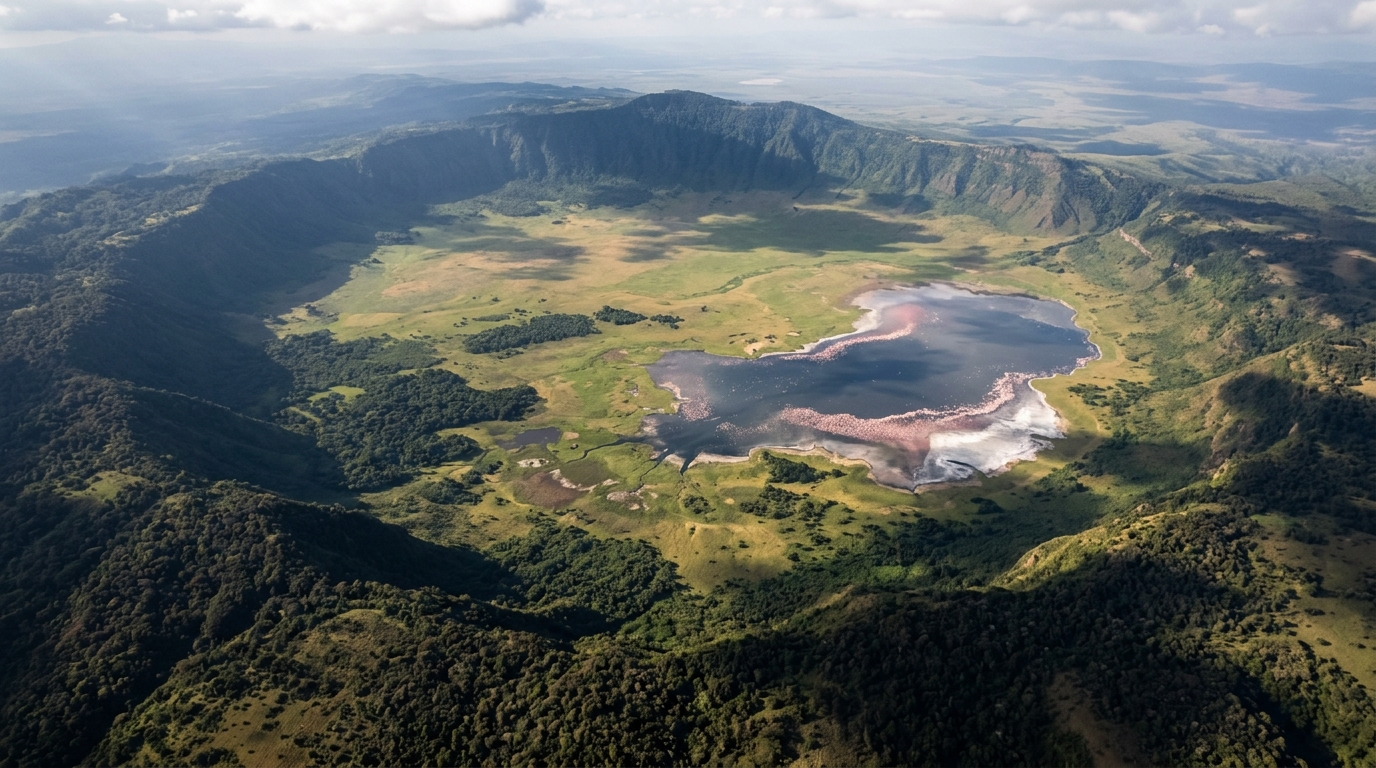
Three million years ago, a volcano collapsed on itself. The magma chamber beneath it emptied or shifted, the mountain above imploded, and the result was a bowl 19 kilometres wide, 600 metres deep, the largest intact volcanic caldera on earth. Over millennia, forest grew on the rim, grassland covered the floor, a soda lake formed in the southwest corner, and animals moved in. They have not left.
The Ngorongoro Crater is the most concentrated wildlife sanctuary in Africa. Approximately 25,000 animals live on its floor year-round, a population held not by fences or management but by the caldera walls themselves, which rise steeply enough that most animals simply do not cross them. Lions have no reason to. Buffalo have no reason to. The rhinos and Ngorongoro holds the most reliably seen black rhinos in Africa — have no reason to. There is water, there is grass, there are prey animals in abundance, and the walls have been there their entire lives.
This is the complete guide to one of the great places on earth.
Ngorongoro at a Glance — Key Facts for 2026
| Detail | Information |
|---|---|
| Location | Northern Tanzania, 180 km west of Arusha |
| Caldera size | 19 km diameter; 264 km² floor area |
| Caldera depth | 600 m from rim to floor |
| Rim elevation | ~2,300 m above sea level |
| Floor elevation | ~1,700 m above sea level |
| Conservation area | 8,292 km² (includes crater, crater rim, adjacent areas) |
| UNESCO status | World Heritage Site (1979) |
| Managing authority | Ngorongoro Conservation Area Authority (NCAA) |
| Resident animal population | ~25,000 individuals |
| Black rhino population | ~23–28 individuals |
| NCA entrance fee (non-resident) | USD $80 per person per day |
| Crater descent fee | USD $350 per person per descent |
| Maximum time in crater | 6 hours per day visit |
| Distance from Serengeti | ~1.5–2 hours to Serengeti boundary |
| Bird species | 500+ in the conservation area |
What Makes Ngorongoro Truly Extraordinary
Most wildlife sanctuaries manage animals within their borders through active intervention — water management, anti-poaching, habitat control. Ngorongoro does not need to. The caldera is its own management system.
The crater walls rise steeply on all sides — steep enough that most large mammals have no motivation to cross them. There is sufficient food, water, and territory within the caldera to sustain a population of approximately 25,000 animals without the need for seasonal migration or territory expansion. The result is a sanctuary in the purest possible sense: a self-enclosed, self-sustaining ecosystem that has been operating independently for longer than any human conservation project.
The permanence matters. In most East African parks, your wildlife encounter is probabilistic — animals are somewhere, you have to find them in a large area, and your chances depend on season, weather, and luck. In Ngorongoro, the animals are in the crater. All of them. The 264 square kilometres of the crater floor contains essentially everything visible from the rim. The game viewing is extraordinarily concentrated as a result.
The geology matters too. The caldera’s rim sits at approximately 2,300 metres above sea level — highland country covered in montane forest, cloud, and cool air. The drive down from the rim is one of East Africa’s most dramatic experiences: the forest gives way, the crater floor comes into view 600 metres below, and the full scale of what you are entering becomes suddenly apparent. The drop is vertiginous. The view is vast. And then the descent road switchbacks into it.
What to See on the Ngorongoro Crater Floor
The Big Five — All Present
The Ngorongoro Crater is one of the relatively few places on earth where all five of the traditional Big Five can be seen in a single day visit. This is not guaranteed, nothing in wildlife is, but the enclosed population, the lack of migration, and the relatively small area make it more achievable here than almost anywhere else.
Lions: Several resident lion prides have territories on the crater floor. Ngorongoro’s lions have been studied for decades and are among the best-documented lion populations in Tanzania. They are visible throughout the day — sleeping under acacias in the morning heat, active at dawn and dusk. The crater’s lions have some of the highest inbreeding coefficients of any lion population in Africa, a consequence of the population’s partial isolation within the caldera.
Leopard: Present but less reliably seen than in, say, Samburu or the Mara. The crater’s open terrain offers fewer of the elevated resting positions that leopards prefer. Encounters occur but require either early morning timing or fortune.
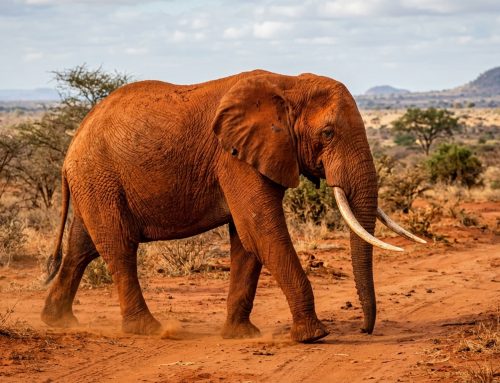
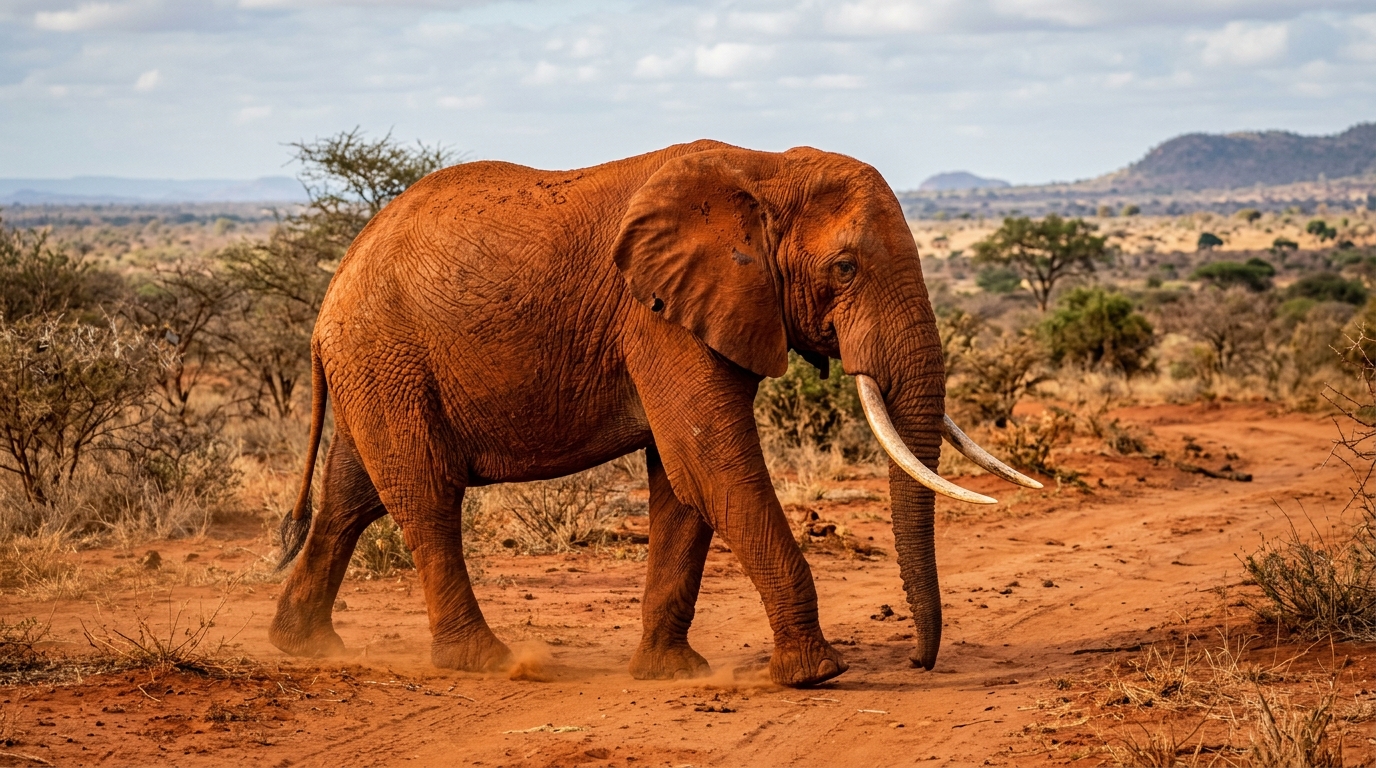
Elephant: A small number of large bulls visit the crater floor — typically older males with impressive ivory. Family herds are more common on the crater rim than the floor. The caldera’s bull elephants are among the most famous in Tanzania, some carrying tusks that reach to the ground.
Cape buffalo: Buffalo are present in some of the largest herds visible in Tanzania’s northern circuit — dense, dark masses moving across the crater floor in the morning hours, concentrating at the swamp and lake margins at midday.
Black rhino: The reason many visitors specifically choose the Ngorongoro Crater over other destinations. See the dedicated section below.
The Black Rhino — Ngorongoro’s Unique Draw
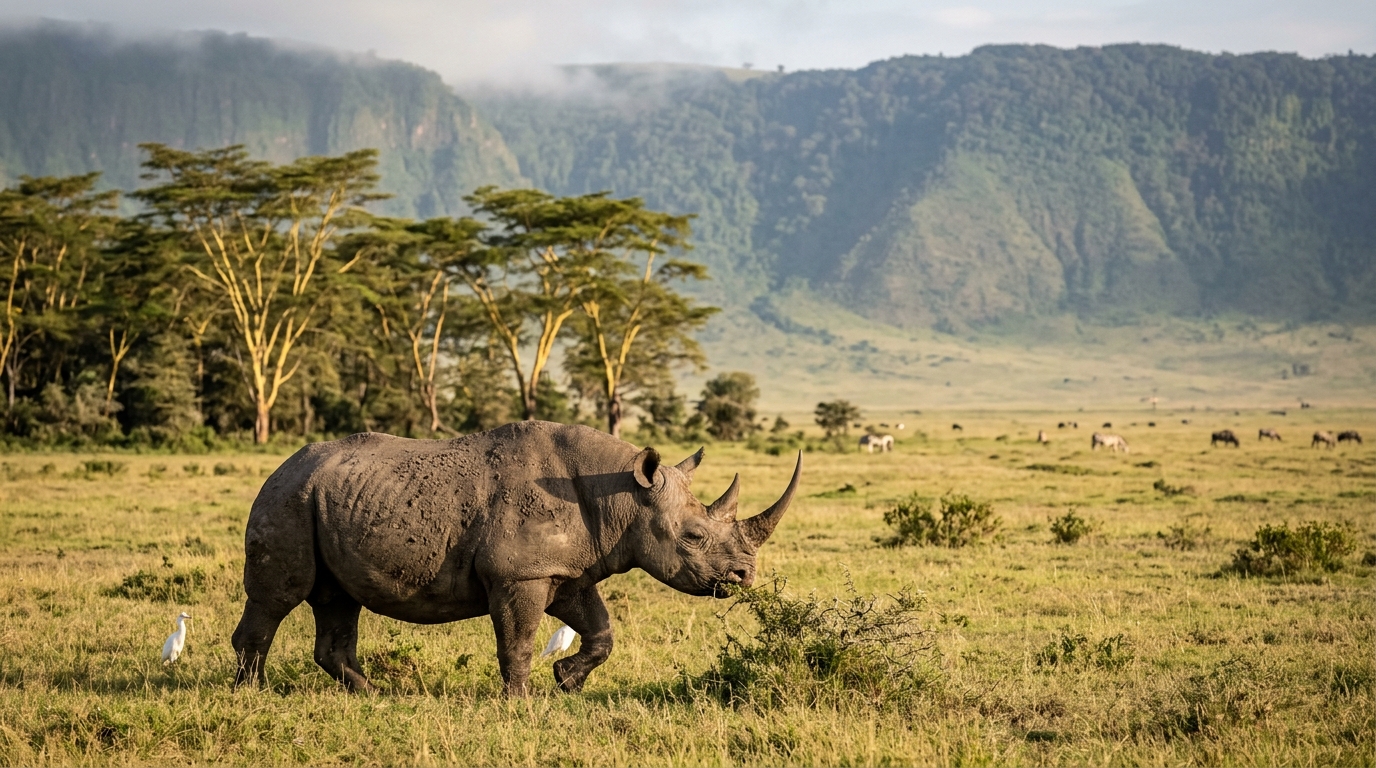
The Ngorongoro Crater holds approximately 23 to 28 black rhinoceros (Diceros bicornis) on its floor — a small population by any absolute measure, but one that is extraordinarily reliably seen relative to black rhinos anywhere else on earth.
Black rhinos are critically endangered with a global population of approximately 6,500. They are cryptic, territorial, prone to dense bush habitat, and in most protected areas across Africa, a sighting requires days of patient effort or significant luck. In Ngorongoro, the enclosed 264-square-kilometre crater floor means the animals are always within the area, always findable by experienced guides, and visible in the open grassland margins and Lerai Forest where they feed and rest.
A Ngorongoro black rhino sighting typically involves an animal at 50 to 200 metres — close enough for clear observation of the characteristic features that distinguish black from white rhino: the hooked (prehensile) upper lip adapted for browsing, compared to the white rhino’s square lip adapted for grazing. The black rhino’s lip is its most important field identification feature and is visible at reasonable range.
The NCAA operates a rhino tracking and identification programme, and local guides maintain current knowledge of the positions of specific individuals making the black rhino sighting in Ngorongoro more a matter of guide expertise than luck. This predictability is what brings visitors specifically to Ngorongoro for this species when Samburu’s much larger Ol Pejeta population has a waiting list and South Africa’s options require separate travel planning.
Lake Magadi and the Flamingos
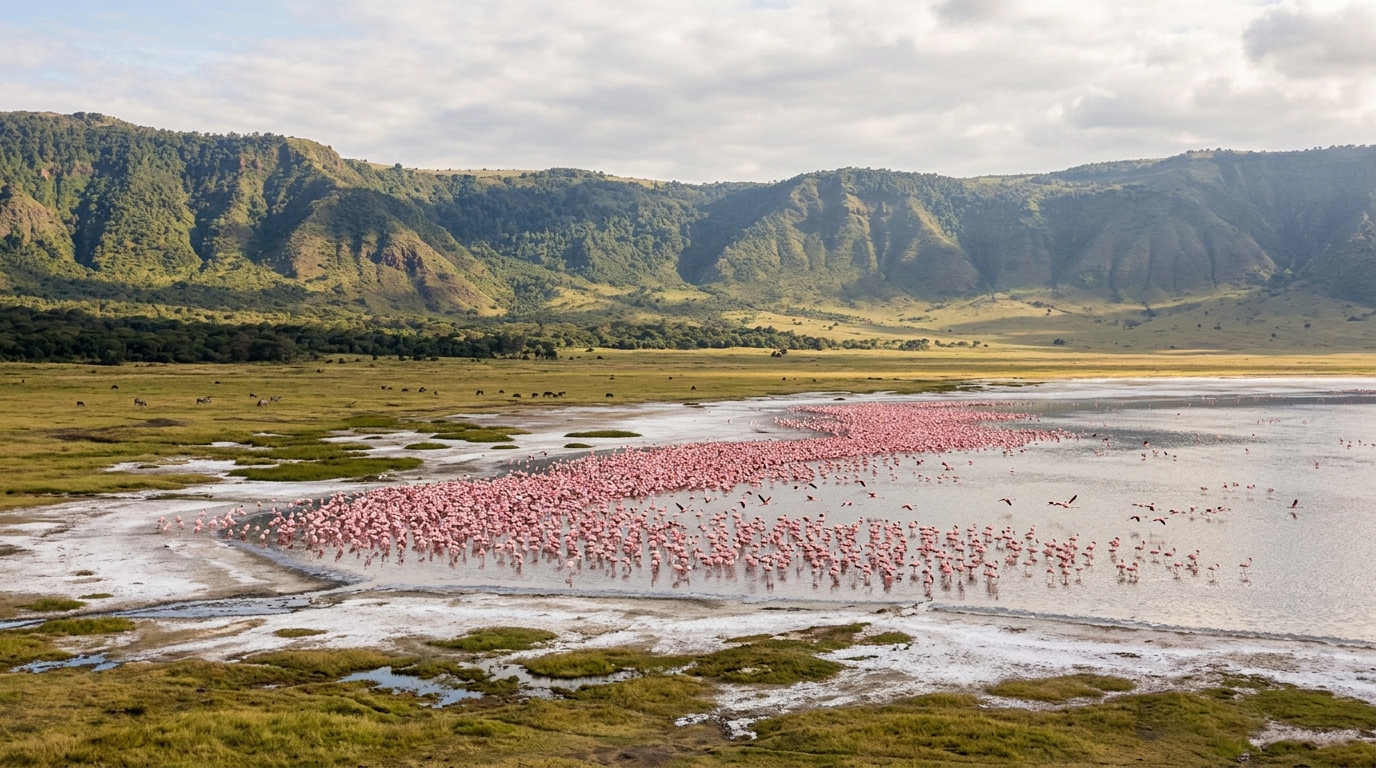
In the southwestern section of the crater floor, an alkaline soda lake sits at the lowest point of the caldera — Lake Magadi (not to be confused with the Lake Magadi in Kenya’s Rift Valley). The lake’s alkalinity fluctuates seasonally, but in productive periods it turns pink with concentrations of lesser flamingos (Phoeniconaias minor) that arrive to feed on the blue-green algae that grows in the alkaline shallows.
The flamingo spectacle varies with lake conditions — in good years, hundreds to thousands of birds create a pink fringe around the lake margin. In drier or lower-water periods, the flamingos may be fewer or absent. The visual effect when flamingos are present ,the pink lake against the green crater floor, enclosed by the caldera walls rising to the forested rim is one of Tanzania’s most distinctive images.
Other waterbirds at Lake Magadi: The lake margin supports hippos, wading species including yellow-billed stork and various herons, and the crater’s spotted hyenas that frequently patrol the shallows looking for disoriented flamingos. Hyenas in Ngorongoro are present at one of the highest densities recorded anywhere, the enclosed prey population and the hyena clan territories established over generations have created a hyena stronghold that consistently surprises visitors more familiar with lions as the dominant crater predator.
The Descent into the Crater
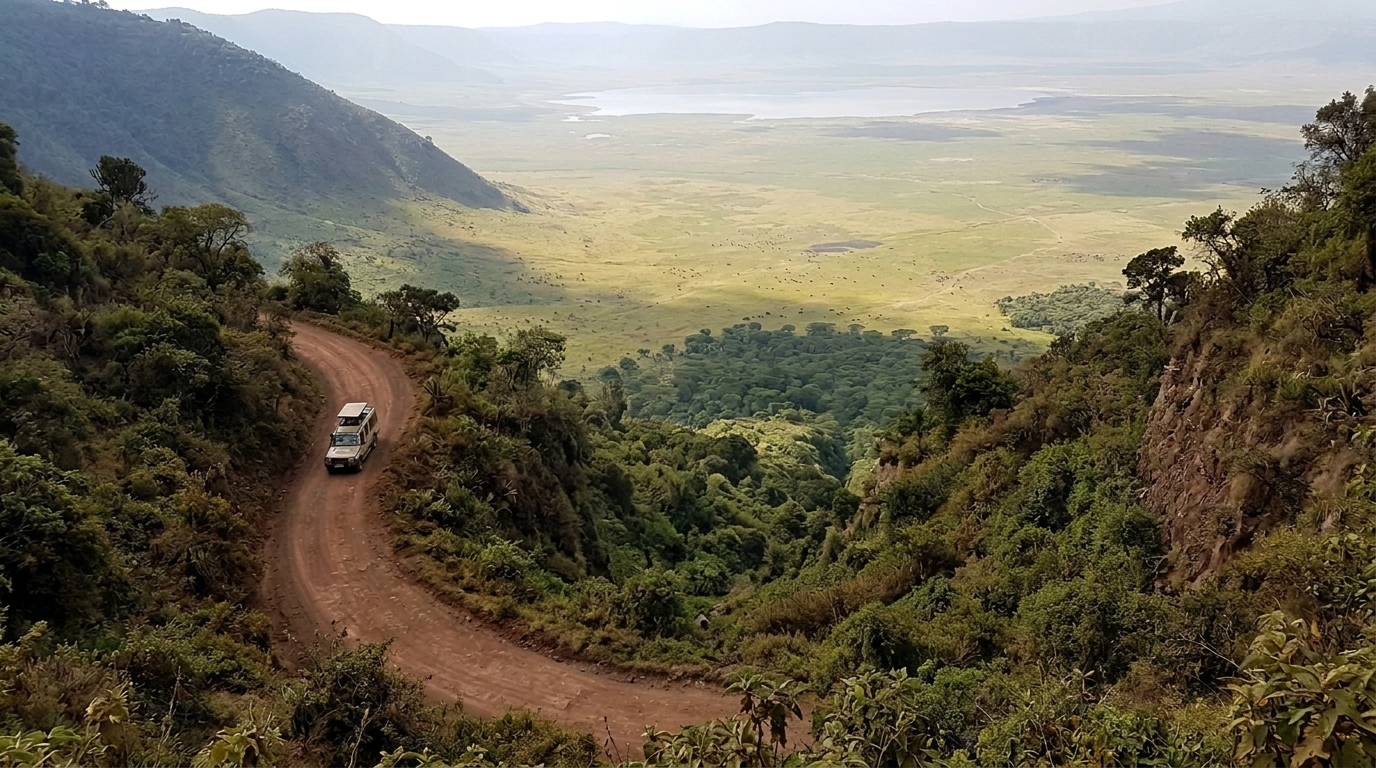
The Ngorongoro Crater descent is a one-way road — vehicles descend on the western side and ascend on the eastern side. The descent begins at the crater rim, passes through highland montane forest (where colobus monkeys and other highland species are often seen), and then emerges at the crater floor as the forest thins and the open grassland begins.
The descent road is steep and has hairpin bends. It is manageable for any well-maintained 4×4, but the exposure the crater floor visible hundreds of metres below through gaps in the vegetation as you wind down — produces a particular quality of anticipation that few drives anywhere can match.
The six-hour limit: All visitors to the Ngorongoro Crater floor are subject to a maximum stay of 6 hours per day visit. The limit is enforced by the NCAA to manage vehicle density and ecosystem disturbance. Plan your timing accordingly — most visitors descend at 6:30 to 7:00 AM to make the most of the morning activity period and exit before or around midday.
Early descent advantage: The crater floor at dawn — before most visitor vehicles have arrived — has a quality that later hours cannot replicate. Lion prides moving at first light, hyenas active from their evening hunts, and the specific quality of early morning light at 1,700 metres elevation on a highland crater floor. Arrange an early descent.
Ngorongoro Beyond the Crater
The Ngorongoro Conservation Area covers 8,292 square kilometres — far larger than the crater itself. Several experiences outside the caldera are worth the time.
Olduvai Gorge — The Cradle of Humanity
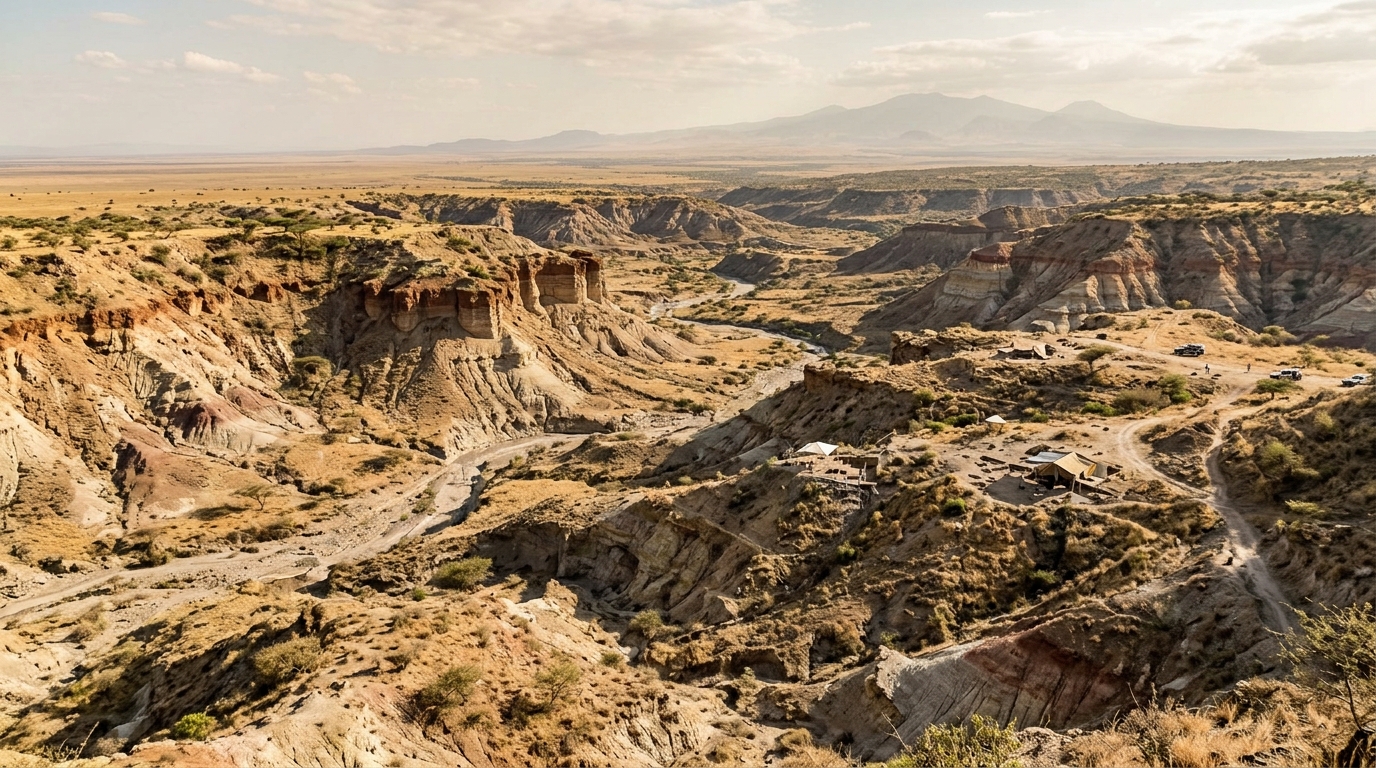
Forty-five kilometres west of the crater, the Olduvai Gorge (also spelled Oldupai Gorge) is one of the most significant archaeological sites in the world. It is here that Mary and Louis Leakey, working from the 1930s through the 1970s, recovered fossils of Homo habilis — one of our earliest confirmed ancestors — along with stone tools and the fossilised footprints of early hominins at Laetoli, 45 km south.
The gorge is a ravine cut through volcanic strata laid down over 2 million years, exposing geological layers that function as a natural time record of East African human origins. A small but genuinely informative museum at the site explains the discoveries in context. A guided visit takes approximately 1.5 to 2 hours and is among the most intellectually rewarding safari additions available in Tanzania.
Crater Rim Walks and Maasai Culture
The crater rim itself, at approximately 2,300 metres, cooler and often misty — offers walks through montane forest with different highland species from the crater floor. Maasai communities live on the rim and in the wider NCA, their cattle grazing in areas adjacent to the conservation zones. The Maasai were evicted from the crater floor in the 1970s — a controversial historical episode that is part of the conservation area’s complicated past. Community visits to rim villages are available and connect the wildlife experience to its human context.
Fees, Timing, and Practical Details
The Two-Fee Structure
Visiting the Ngorongoro Crater requires two separate payments in addition to vehicle fees:
- NCA entrance fee: USD $80 per person per day (non-resident) — applies to all visitors to the Conservation Area, not just the crater.
- Crater descent fee: USD $350 per person per crater entry — this is the additional fee specifically for descending to the crater floor.
For a couple doing one crater descent day, the fees alone total USD $860 before vehicle charges, accommodation, or guide fees. These are included transparently in Crescent Shores’ Tanzania package quotes — no hidden additions.
What to Bring
- Warm layers: The crater rim and early morning on the floor can be cold (10–15°C at dawn)
- Binoculars: Essential for rhino identification and distant predator watching
- Camera: 100–400mm telephoto for wildlife photography on the open crater floor
- Water and food: No restaurants on the crater floor; bring a packed breakfast from your lodge
- Sunscreen: The altitude and equatorial sun combination is deceptive — UV exposure at 1,700m is significant
Combining Ngorongoro in a Tanzania Itinerary
Ngorongoro sits directly on the road between Arusha and the Serengeti — a location that makes it a natural stop on any northern Tanzania circuit. The standard route:
- Day 1–2: Arusha (arrival, acclimatise)
- Day 3: Drive Arusha → Ngorongoro rim (3 hours). Afternoon rim walk or cultural visit.
- Day 4: Full-day Ngorongoro Crater descent (6 hours maximum on floor)
- Day 5: Drive Ngorongoro → Serengeti (2 hours to boundary, then into the park)
- Days 5–8: Serengeti game drives (zone matched to migration season)
We build this Tanzania circuit from Nairobi — including the Kenya-to-Tanzania crossing, all accommodation, permits, crater fees, and guide services — as a single package. Ngorongoro is included in every full Tanzania itinerary we offer.
Plan Your Ngorongoro Safari with Crescent Shores Retreats
📞 WhatsApp or call: +254 790 292 838 📧 Email: welcome@crescentshoresretreats.com 🌐 Tanzania Safari Guide: Serengeti, Ngorongoro & Beyond → 🌐 Kenya-Tanzania comparison: Kenya vs Tanzania Safari → 🌐 Build your itinerary: Contact Our Team →
Frequently Asked Questions — Ngorongoro Crater
What is the Ngorongoro Crater?
The Ngorongoro Crater is the world’s largest intact volcanic caldera — a 19-kilometre-wide, 600-metre-deep bowl formed when a large volcano collapsed on itself approximately 3 million years ago. Located in northern Tanzania within the Ngorongoro Conservation Area (UNESCO World Heritage Site), its floor holds approximately 25,000 animals year-round. The caldera walls act as a natural enclosure, keeping wildlife concentrated on the 264 km² floor without fencing or active management.
How much does it cost to visit the Ngorongoro Crater in 2026?
Two separate fees apply for non-resident visitors. The Ngorongoro Conservation Area entrance fee is USD $80 per person per day — this covers access to the conservation area. The crater descent fee is an additional USD $350 per person per crater entry — specifically for descending to the crater floor. For a couple doing one crater descent day, fees total USD $860 before vehicle charges, guide fees, or accommodation. All fees are included in Crescent Shores’ all-inclusive Tanzania package prices.
Is Ngorongoro the best place to see black rhino in Africa?
It is one of the most reliable locations in the world for close black rhino sightings. The crater floor holds approximately 23 to 28 black rhinos in a manageable 264 km² area — guides maintain current knowledge of specific individuals’ locations, making the sighting more a matter of guide expertise than luck. Black rhinos in most African parks are extremely difficult to find in large, open landscapes. The caldera’s enclosed nature concentrates them in predictable areas in a way that no other rhino destination can replicate.
How long can you stay inside the Ngorongoro Crater?
The maximum permitted time on the Ngorongoro Crater floor is 6 hours per visit, enforced by the Ngorongoro Conservation Area Authority to manage vehicle density. Most visitors descend at 6:30 to 7:00 AM to maximise the morning activity period and exit by 12:30 to 1:00 PM. Plan an early descent — the crater floor at dawn has a quality that later hours cannot replicate, and the most productive predator activity occurs in the first 2 to 3 hours after descent.
Is Ngorongoro better than the Serengeti?
Different rather than better, they offer completely different experiences. The Serengeti has enormous scale (14,763 km²), the wildebeest migration, and wilderness that rewards extended visits. Ngorongoro has concentrated wildlife in a spectacular geological setting and the most reliable Big Five viewing — including black rhino — of any single location in Tanzania. Most Tanzania itineraries include both. As a one-location Tanzania safari, Ngorongoro provides more guaranteed wildlife variety per day on the crater floor; the Serengeti provides more wilderness scale and migration drama.
Can you see the Big Five in Ngorongoro Crater?
Yes — the Ngorongoro Crater is one of Africa’s best locations for seeing all five of the traditional Big Five (lion, leopard, elephant, Cape buffalo, and black rhino) in a single day. The enclosed caldera concentrates a permanent population of all five species in 264 km². Black rhino is particularly reliable at Ngorongoro compared to almost anywhere else — the crater is the most consistent location in Africa for this endangered species.
— Crescent Shores Retreats, Naivasha, Kenya Naivasha-based safari tour operator · Kenya · Tanzania · Uganda · Rwanda +254 790 292 838 · welcome@crescentshoresretreats.com

Leave A Comment