
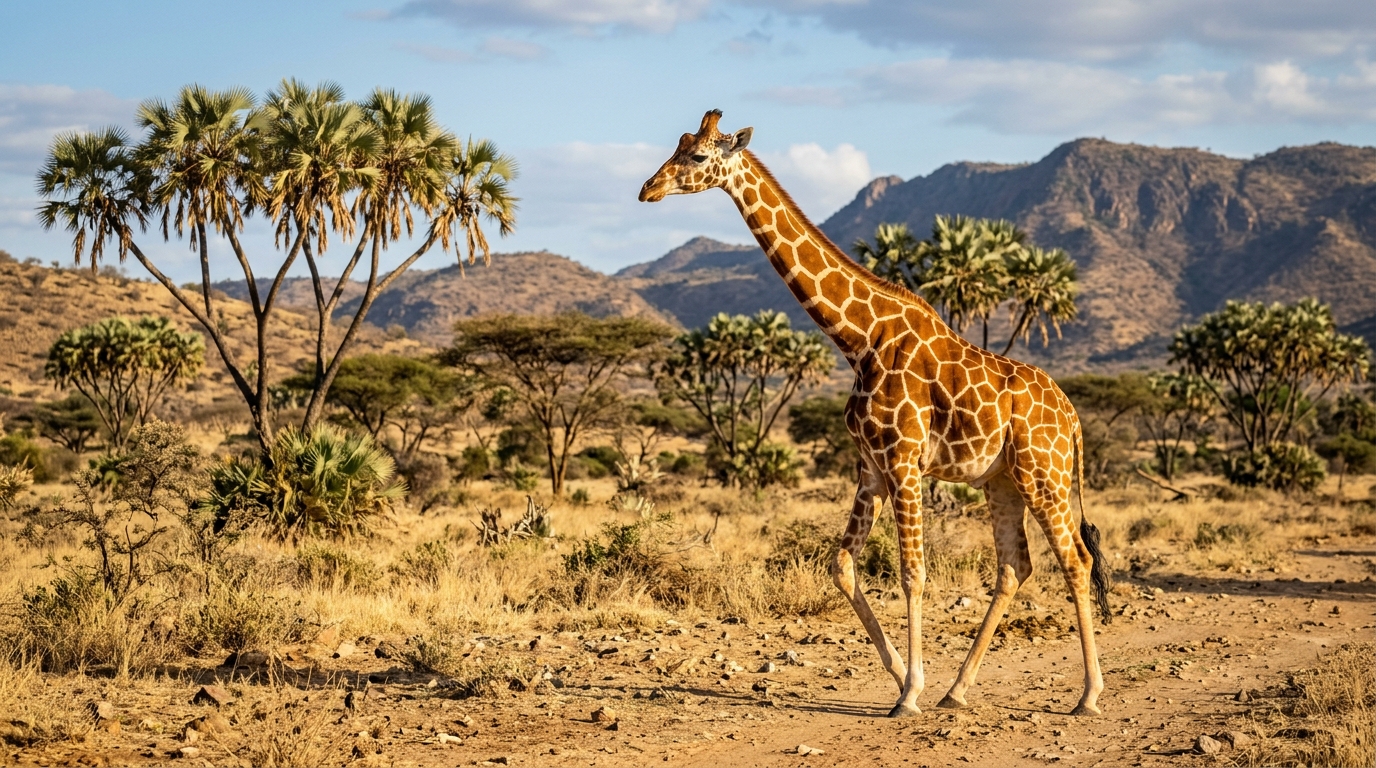
Samburu National Reserve is where Kenya’s wildlife list stops repeating itself.
Every park from the Mara to Amboseli to Tsavo shares the same core cast: Maasai giraffe, Burchell’s zebra, common ostrich, Thomson’s gazelle, the familiar supporting characters of East African safari. They are extraordinary animals. You will never tire of them. But in Samburu’s semi-arid north, 350 kilometres from Nairobi and a world away in ecological character, five species occur that exist nowhere else in Kenya — animals so specifically adapted to the dry north that they are simply absent from every park south of here.
Those five are the Samburu Special Five. Learning their names and recognising them changes the Samburu experience from “another game drive” to a wildlife checklist that drives real focus and real satisfaction when completed. And Samburu’s leopard, drawn out of hiding by the Ewaso Ng’iro River running through the heart of the reserve, is among the most reliably visible in the country.
Samburu at a Glance — Key Facts for 2026
| Detail | Information |
|---|---|
| Location | Northern Kenya, 350 km from Nairobi |
| Reserve size | 165 km² (plus adjacent Buffalo Springs 194 km²) |
| Elevation | ~800–1,200 m above sea level |
| Entry fee (non-resident) | USD $85 per person per day |
| Entry fee (EAC resident) | KES 800 per person per day |
| Park authority | Kenya Wildlife Service (KWS) |
| Getting there | 5–6 hours by road; ~1 hour by air from Wilson Airport |
| Main river | Ewaso Ng’iro (flows through both Samburu and Buffalo Springs) |
| Signature experience | Samburu Special Five; leopard at the river |
| Adjacent reserves | Buffalo Springs (south bank), Shaba (east) |
| Best time | Year-round; dry season June–Oct and Jan–Feb best |
| Bird species | 450+ recorded |
The Samburu Special Five — Species Found Only in Northern Kenya
[PHOTO 02]
The Samburu Special Five are five species whose range in Kenya is restricted to the north — they exist in northern Kenya, parts of Somalia, southern Ethiopia, and (for some) Eritrea, but are absent from the Mara, Amboseli, Tsavo, Naivasha, and all of southern Kenya. Seeing all five in a two-night Samburu visit is achievable and deeply satisfying.
1. Reticulated Giraffe (Giraffa reticulata)
The most immediately recognisable of the five, once you know what to look for. The reticulated giraffe’s coat is arranged in bold, regular polygons — geometric tessellations in deep rufous brown, separated by bright white lines of extraordinary precision. This pattern is completely different from the irregular, leaf-like patches of the Maasai giraffe found in southern Kenya, and the difference is visible at 200 metres.
Reticulated giraffes are found across Samburu, often in small groups of 3 to 8 individuals, browsing the flat-topped acacias that characterise the reserve. They are common enough that most morning game drives encounter them within the first 30 minutes. Seeing one beside a Maasai giraffe where the pattern difference is immediately apparent is one of the most satisfying comparative wildlife moments available in Kenya.
2. Grevy’s Zebra (Equus grevyi)
The world’s largest wild equid and an endangered species with a global population of approximately 2,500 to 3,000 individuals of which roughly 70% live in Kenya, primarily in the Samburu area and the Laikipia plateau.
The Grevy’s zebra is distinguishably different from the Burchell’s (plains) zebra you see everywhere else in Kenya:
- Narrower stripes, more numerous, that do not extend across the belly (the belly is white in Grevy’s)
- Larger, more rounded ears (donkey-like rather than horse-like)
- Taller and heavier body frame
Grevy’s zebra is typically found in smaller groups than Burchell’s and ranges across the drier parts of the reserve and Buffalo Springs. Its endangered status makes a sighting in Samburu something more than just a species tick, it is an encounter with an animal that is genuinely rare and that Kenya’s conservation infrastructure is actively working to protect.
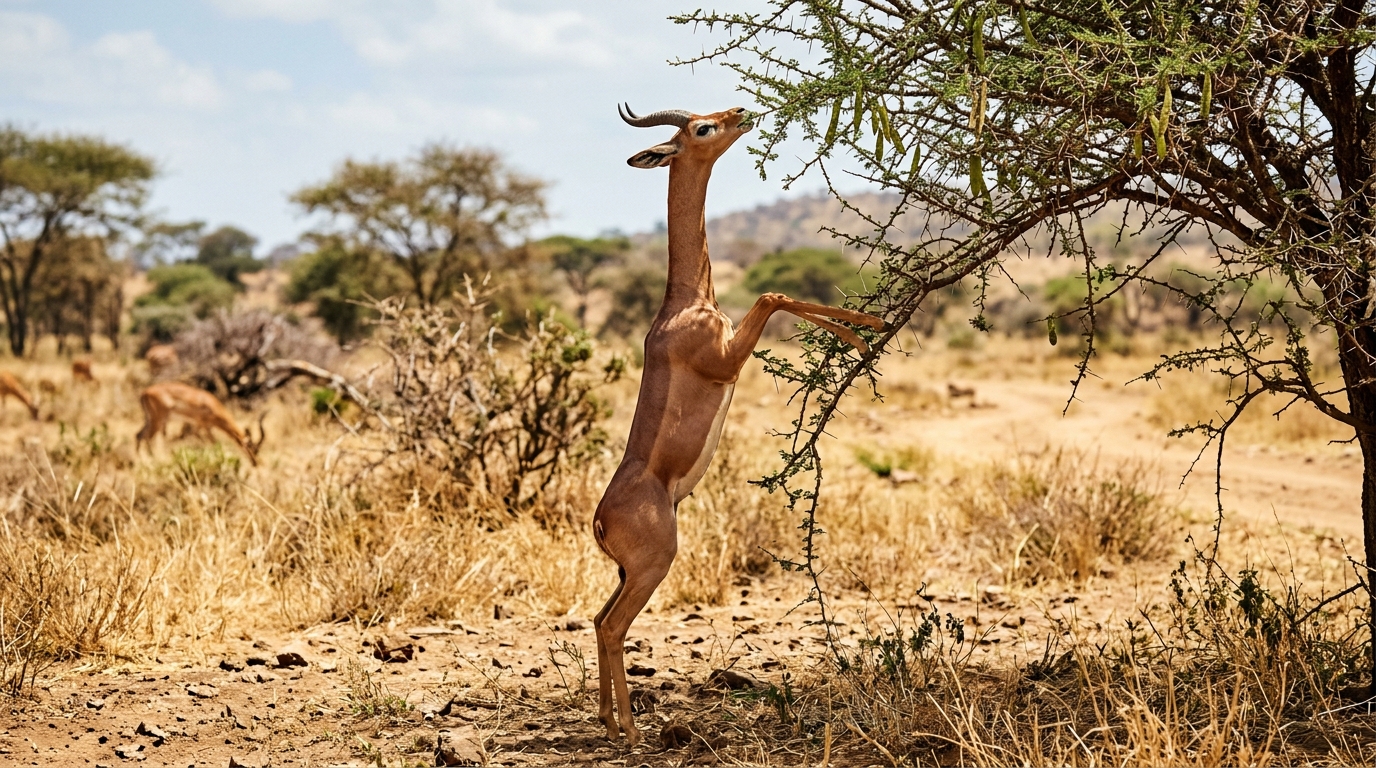
3. Gerenuk (Litocranius walleri)
The gerenuk is an antelope that has taken specialisation to an extreme that other ungulates cannot match. Its name comes from the Somali word for “giraffe-necked” — and its neck is indeed extraordinarily elongated, out of proportion to its body, giving it access to browse that no other antelope in its range can reach.
What makes the gerenuk unmistakable is its feeding posture. It stands on its hind legs completely upright, front legs bracing against the branch, neck fully extended — and browses at heights of 1.5 to 2 metres that competing species cannot reach. No other antelope anywhere on earth does this. A gerenuk feeding on an acacia is one of those animal behaviours so specific and unexpected that first-time observers simply stop and stare.
4. Beisa Oryx (Oryx beisa)
A large, striking antelope with a distinctive black-and-white face, swept-back horns that appear almost too long and straight to be functional, and a body so well-adapted to arid conditions that it can raise its body temperature rather than sweat conserving water that would otherwise be lost to cooling.
The Beisa oryx’s horns are both sexes’ — males and females both carry them, typically 60 to 100 centimetres in length. Seen in a group against the red soil of Samburu, the long-horned, patterned-face silhouette is immediately distinctive.
5. Somali Ostrich (Struthio molybdophanes)
The most recent addition to the Special Five list, and the one most visitors initially miss because it requires knowing what to compare. The Somali ostrich is a separate species from the common ostrich (Struthio camelus) — formally distinguished in 2014.
The key visible difference: where the common ostrich (found in southern Kenya’s parks) has pink neck and thighs, the Somali ostrich has blue-grey neck and thighs — a striking difference visible at modest range in good light. It is found in exactly the same habitat as the common ostrich but only in northern Kenya and the Horn of Africa.
The Ewaso Ng’iro River — Heart of the Reserve
The Ewaso Ng’iro River flows west to east through the length of Samburu and Buffalo Springs National Reserves, creating a permanent water source in a landscape that would otherwise be unpredictably dry. Everything in the reserve’s ecology is organised around this river — water, shade, browse, and the predators that wait for the prey that must come to drink.
Leopard — Samburu’s Outstanding Predator Sighting
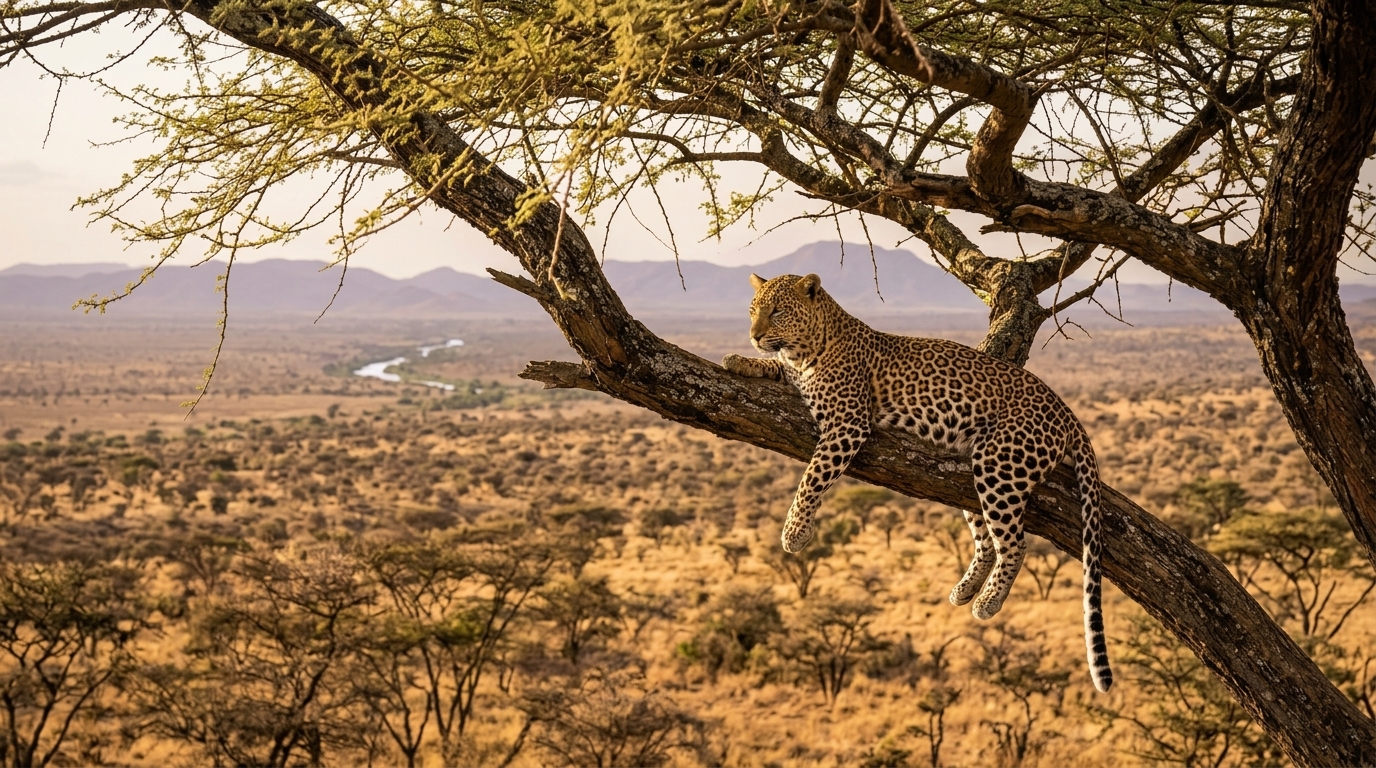
Samburu is consistently ranked as one of Kenya’s most reliable locations for leopard sightings — a reputation built on the specific character of the Ewaso Ng’iro’s riverine forest. The dense acacia and fig woodland along the river bank gives leopards exactly what they need: deep shade, elevated resting positions, ambush cover near the water where prey concentrates, and proximity to the kills they cache in trees away from lions and hyenas.
Leopards are seen regularly in Samburu’s riverside acacias — often resting in the crook of a large branch in the early morning, visible from 50 to 100 metres on the opposite bank. Samburu guides with years of experience along the river know specific trees with regular leopard occupants. A riverside game drive at dawn in Samburu produces leopard encounters at a rate that the Mara, for all its fame, rarely matches for this specific species.
Hippos, Crocodiles and the River Experience
Hippos occupy the deeper pools of the Ewaso Ng’iro in permanent pods. Nile crocodiles large, prehistoric, completely indifferent to the proximity of vehicles on the bank — sun themselves on the sandy beaches between the river’s channels. The combination of hippo vocalisations, crocodile stillness, and the leopard resting in the tree above them while a reticulated giraffe drinks 30 metres downstream is the Samburu river experience at its most complete.
Samburu’s Predators — A Landscape That Rewards Patience
Beyond the leopard, Samburu’s predator sightings are excellent and span more species than the reserve’s modest size suggests.
Lions are present throughout the reserve, with several resident prides that are well-known to local guides. The open scrub habitat makes lion sightings visually cleaner than in bush-heavy environments — a lion at rest under an acacia with no obscuring vegetation is a photographic gift.
Cheetahs use the reserve’s open ground for hunting and are seen regularly in the eastern sections of Buffalo Springs. The flat terrain and good visibility make cheetah hunts observable in Samburu in ways that denser landscapes prevent.
African wild dogs are occasionally seen in Samburu — a significant sighting given the species’ rarity across Kenya. The reserve’s position in a landscape corridor that connects to larger rangelands to the north gives wild dog packs ranging space that makes their occasional appearance more likely than in enclosed parks.
The Samburu People
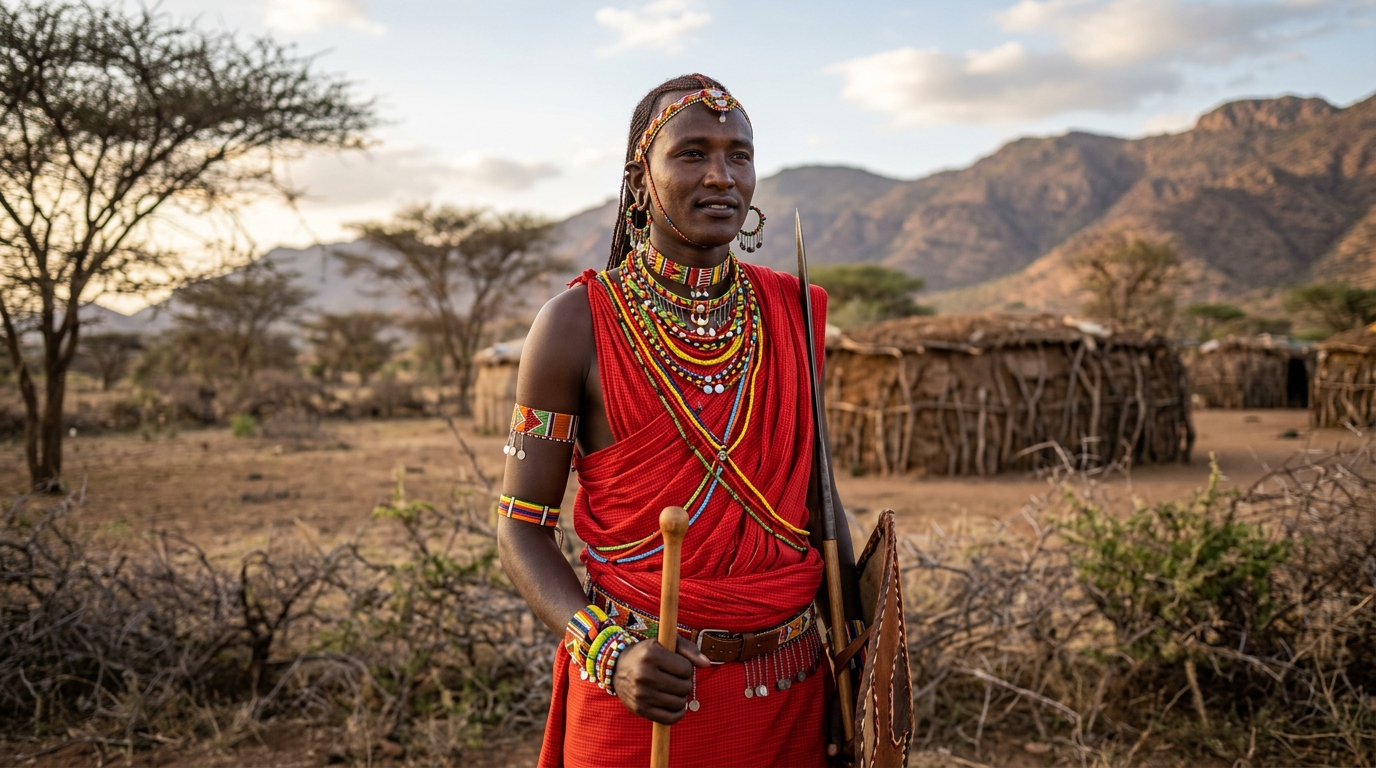
The Samburu people are the dominant human community of northern Kenya’s reserves and the surrounding landscape. They are closely related to the Maasai sharing a Nilotic language family and similar material culture (the characteristic red shukas, beadwork, and elongated earlobes) — but are distinct in their range, their specific oral traditions, and their adaptation to a drier, more nomadic pastoral lifestyle than the Maasai of the south.
Samburu communities live within and adjacent to the reserve boundaries. The relationship between the Samburu people and the wildlife is complex and evolving — the reserve itself was established without full community consultation in the colonial era, and building genuine partnership between conservation interests and pastoral community income has been ongoing work since independence.
Today, several lodges in and around the reserve invest in community benefit funds, employ Samburu guides, and arrange village visits that give visitors an authentic introduction to Samburu material culture, diet, and social structure. When arranged through reputable operators who pay the visit fee directly to the community, these visits are worthwhile and genuinely educational.
The Samburu Landscape — Northern Kenya’s Character
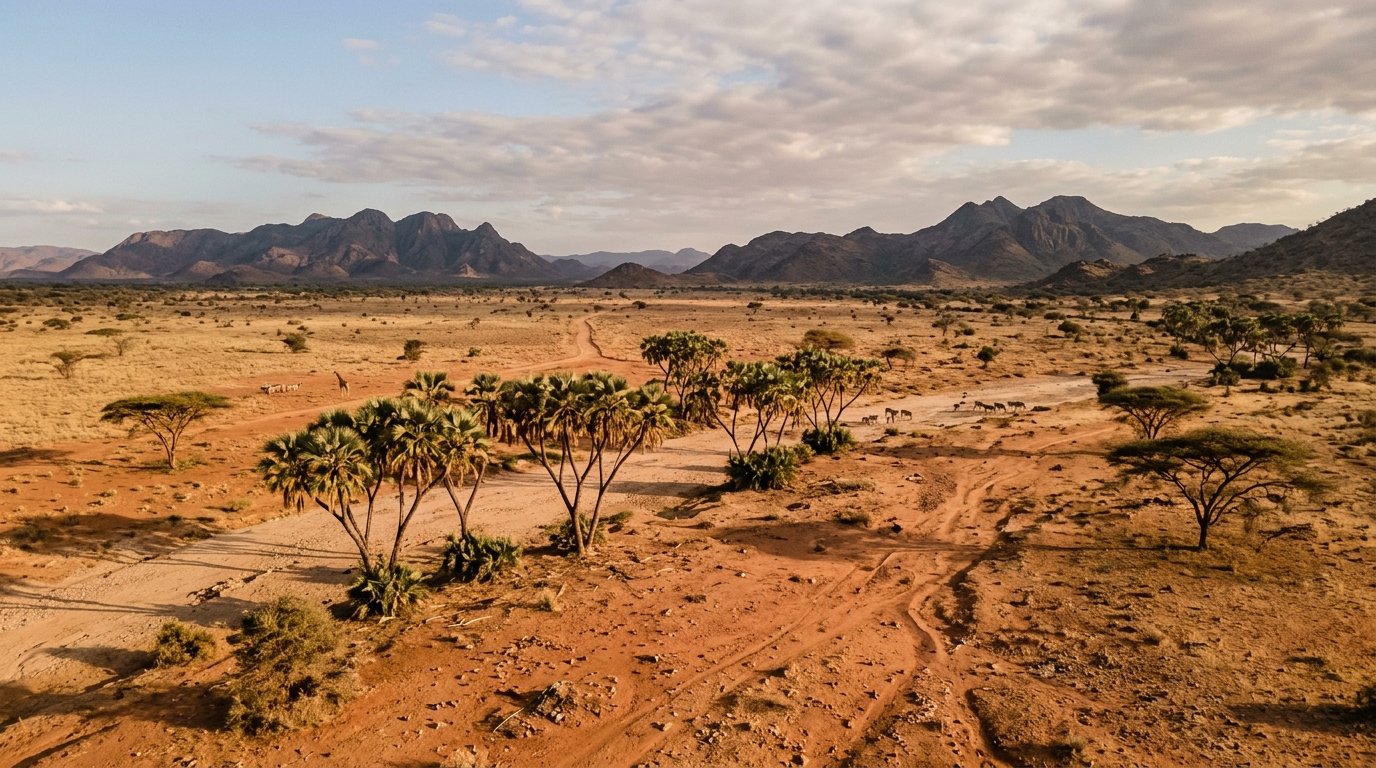
Samburu looks like nowhere else in Kenya’s safari circuit. The vegetation is different: doum palms — tall, branching palms with fan-like leaf crowns — line the river and the sandy luggas (seasonal water channels). Commiphora (myrrh) trees with their papery peeling bark replace the acacia-dominated scrub of the south. The soil is red and sandy. The light has a harsher quality than the Rift Valley — drier, more directional.
The overall impression is of a landscape that is closer to the Horn of Africa in character than to East Africa’s stereotypical safari imagery. This is not a criticism, it is what makes Samburu valuable to travellers who have seen southern Kenya. The difference is complete enough that Samburu feels like a genuinely separate country, not just another park.
Samburu vs Maasai Mara — The Case for the North
The Mara and Samburu are not competing for the same visitor. They offer genuinely different things:
| Criteria | Maasai Mara | Samburu |
|---|---|---|
| Special Five | None | All five |
| Wildebeest migration | Yes (Jul–Oct) | No |
| Leopard | Good | Excellent (river habitat) |
| Vehicle density | High in peak season | Very low year-round |
| Landscape | Rolling grass savanna | Arid scrub, doum palms |
| Entry fee | USD $200 (peak) / $100 (low) | USD $85 (year-round) |
| First Kenya visit | Ideal | Better as second visit |
| Repeat visitors | Familiar | Genuinely new species |
Samburu is not a replacement for the Mara. It is what comes after the Mara — the park that experienced Kenya safari visitors seek when the Maasai giraffe and Burchell’s zebra have become familiar and they want the thrill of a genuinely new species on their list.
Best Time to Visit Samburu
Samburu’s semi-arid character means it is less seasonally variable than Kenya’s southern parks. The Ewaso Ng’iro River provides water year-round, which prevents the extreme dry-season concentration effect that makes other parks exceptional in specific months and poorer in others.
| Period | Conditions | Recommendation |
|---|---|---|
| June–October (dry) | Dry, dust, excellent game at river | Best game viewing, clearest skies |
| January–February | Short dry season, warm | Excellent; fewer visitors than mid-year |
| March–May (long rains) | Some afternoon rain, green | Lush; some tracks muddy; fewer visitors |
| October–December | Short rains, variable | Good; greener; moderate visitor numbers |
Getting to Samburu from Nairobi
By road: Approximately 350 km from Nairobi via the A2 highway north through Nanyuki/Timau, then east on the B9 road to Archer’s Post (the nearest town to Samburu). Drive time: approximately 5 to 6 hours in normal traffic. The road is sealed as far as Isiolo; the final section to the reserve gate is good murram.
By air: Scheduled and charter flights operate from Wilson Airport in Nairobi to the Samburu airstrips (including Samburu Airstrip and Buffalo Springs). Flight time: approximately 1 hour. This is the recommended option for visitors staying 2 to 3 nights — the road journey at both ends of a short stay adds disproportionate travel time.
Northern circuit combination: Samburu pairs naturally with Ol Pejeta Conservancy (black rhino, chimpanzees, 2.5 hours south) and Lewa Wildlife Conservancy (between Ol Pejeta and Samburu on the northern route) in a 6 to 7-day northern Kenya safari. This route gives you black and white rhino, chimps, all five Special Five, and leopard — a wildlife diversity that no southern Kenya circuit matches. Crescent Shores organises the complete northern circuit.
Plan Your Samburu Safari with Crescent Shores Retreats
📞 WhatsApp or call: +254 790 292 838 📧 Email: welcome@crescentshoresretreats.com 🌐 Kenya Safari Packages: All Kenya Safari Packages 2026 → 🌐 Northern Kenya context: Amboseli National Park Guide → 🌐 Build your itinerary: Contact Our Team →
Frequently Asked Questions — Samburu National Reserve
What is the Samburu Special Five?
The Samburu Special Five are five wildlife species found in northern Kenya but absent from southern Kenya’s parks: the reticulated giraffe (geometric polygon pattern, vs Maasai giraffe’s irregular patches), Grevy’s zebra (narrower stripes, white belly, endangered), gerenuk (stands on hind legs to browse, unique among antelopes), Beisa oryx (long straight horns, black-and-white face, adapted to aridity), and the Somali ostrich (blue-grey neck and thighs, vs pink of common ostrich). All five can typically be seen in a two-night visit to Samburu National Reserve.
What makes Samburu different from the Maasai Mara?
The Maasai Mara and Samburu are genuinely different safari experiences rather than competing versions of the same thing. The Mara has the wildebeest migration, high wildlife density in peak season, and the classic East African savanna landscape. Samburu has the Samburu Special Five (five species found only in northern Kenya), Kenya’s most reliable leopard sightings at the Ewaso Ng’iro River, dramatically lower visitor numbers year-round, and a semi-arid northern landscape that looks and feels completely different from any southern park. The Mara is typically the better first Kenya safari; Samburu is the better second.
Is Samburu worth visiting if I’ve already been to the Maasai Mara?
Very much yes. If you have done the Mara, you have not seen a reticulated giraffe, a Grevy’s zebra, a gerenuk standing on its hind legs, a Beisa oryx, or a Somali ostrich. All five are in Samburu. The leopard sightings along the Ewaso Ng’iro River consistently exceed what the Mara produces. And the landscape — doum palms, red ochre soil, the arid northern character — is a complete departure from the Mara’s rolling green grassland. Experienced Kenya safari visitors regularly cite Samburu as the park that gave them the most new experiences after their first Mara trip.
How do I get to Samburu National Reserve from Nairobi?
By road: approximately 350 km from Nairobi via the A2 highway north through Nanyuki and Isiolo, then east to Archer’s Post — about 5 to 6 hours in normal traffic. By air: scheduled and charter flights from Wilson Airport in Nairobi reach the Samburu airstrips in approximately 1 hour. Air is recommended for visits of 2 to 3 nights. Crescent Shores arranges all transfers as part of Samburu package bookings.
What is the best time to visit Samburu National Reserve?
Samburu is excellent year-round due to the permanent water of the Ewaso Ng’iro River. The June to October dry season and the January to February short dry season offer the best game-viewing conditions with drier tracks and wildlife concentrated at water. The rainy seasons (March–May and October–December) bring lush landscapes, fewer tourists, and slightly more challenging road conditions in places. Unlike southern Kenya’s parks, Samburu’s semi-arid character means the seasonal variation is less extreme.
Can I see leopards in Samburu National Reserve?
Yes — Samburu is one of Kenya’s most reliable leopard-sighting locations. The Ewaso Ng’iro River’s dense riverine acacia forest provides ideal leopard habitat: shade, elevated resting positions, ambush cover, and year-round water. Samburu guides with experience along the river know specific trees with regular occupants and typically produce leopard sightings more consistently than the Mara. Dawn game drives along the river bank are the most productive window, when leopards are still resting from overnight activity.
— Crescent Shores Retreats, Naivasha, Kenya Naivasha-based safari tour operator · Kenya · Tanzania · Uganda · Rwanda +254 790 292 838 · welcome@crescentshoresretreats.com

Leave A Comment