
By Crescent Shores Retreats · Naivasha, Kenya · Published May 2026 · 12 min read
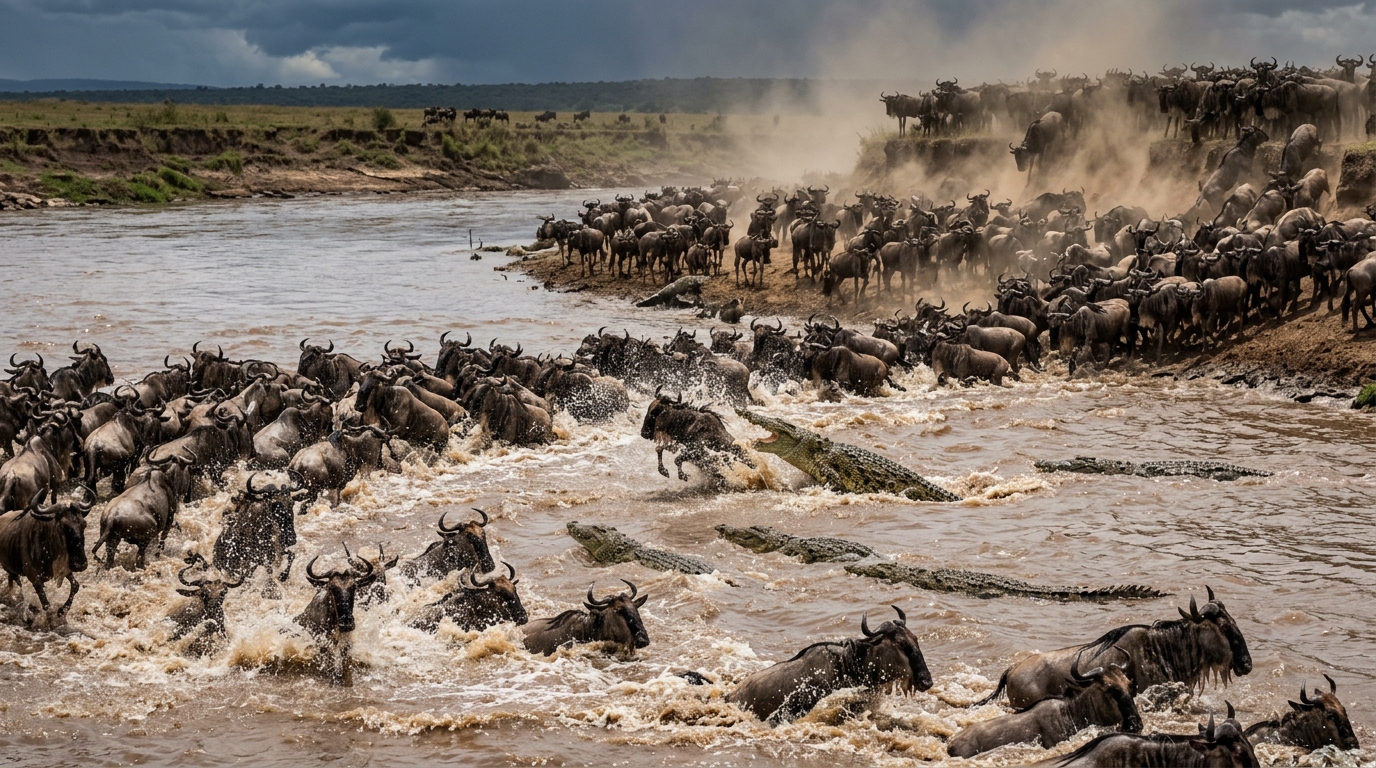
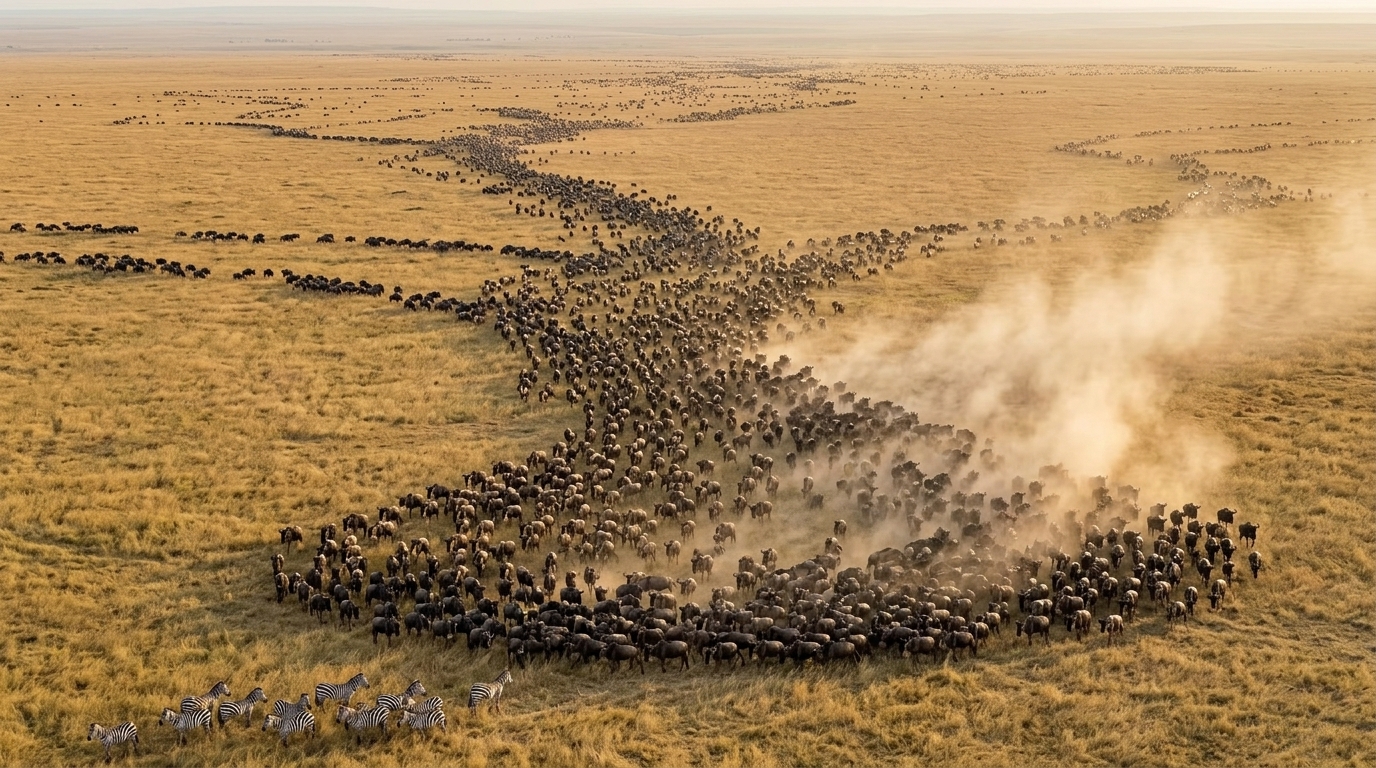
The Great Wildebeest Migration does not have a single start date. It does not run for a few weeks and then stop. It is a year-round cycle — an unbroken loop of movement, birth, grazing, and crossing that has been repeated for over a million years across the Serengeti-Mara ecosystem. Two million wildebeest, 250,000 zebra, and 500,000 Thomson’s gazelle follow the rains and the fresh grass in a continuous circular journey that covers over 2,000 kilometers annually.
When people ask “when is the wildebeest migration?”, what they usually mean is: “when are the famous Mara River crossings?” The answer is July to October — but that is only one chapter of a twelve-chapter story. The calving season in January is arguably more spectacular. The Grumeti crossings in June are almost unknown. The return south in November is quietly magnificent.
This is the complete 2026 migration calendar — every phase, every location, every month.
What Is the Great Wildebeest Migration?
The Great Wildebeest Migration is the largest terrestrial animal migration on earth. Approximately 2 million wildebeest (Connochaetes taurinus) — along with 250,000 zebra and 500,000 Thomson’s gazelle — migrate in a continuous clockwise loop across the Serengeti-Mara ecosystem, straddling the Tanzania-Kenya border.
The migration is driven by a single imperative: grass. Wildebeest graze constantly, depleting the vegetation in any area within weeks. They follow the seasonal rains and the flush of fresh green grass that follows them, moving north when the southern Serengeti dries out and south again when the Kenyan plains do the same.
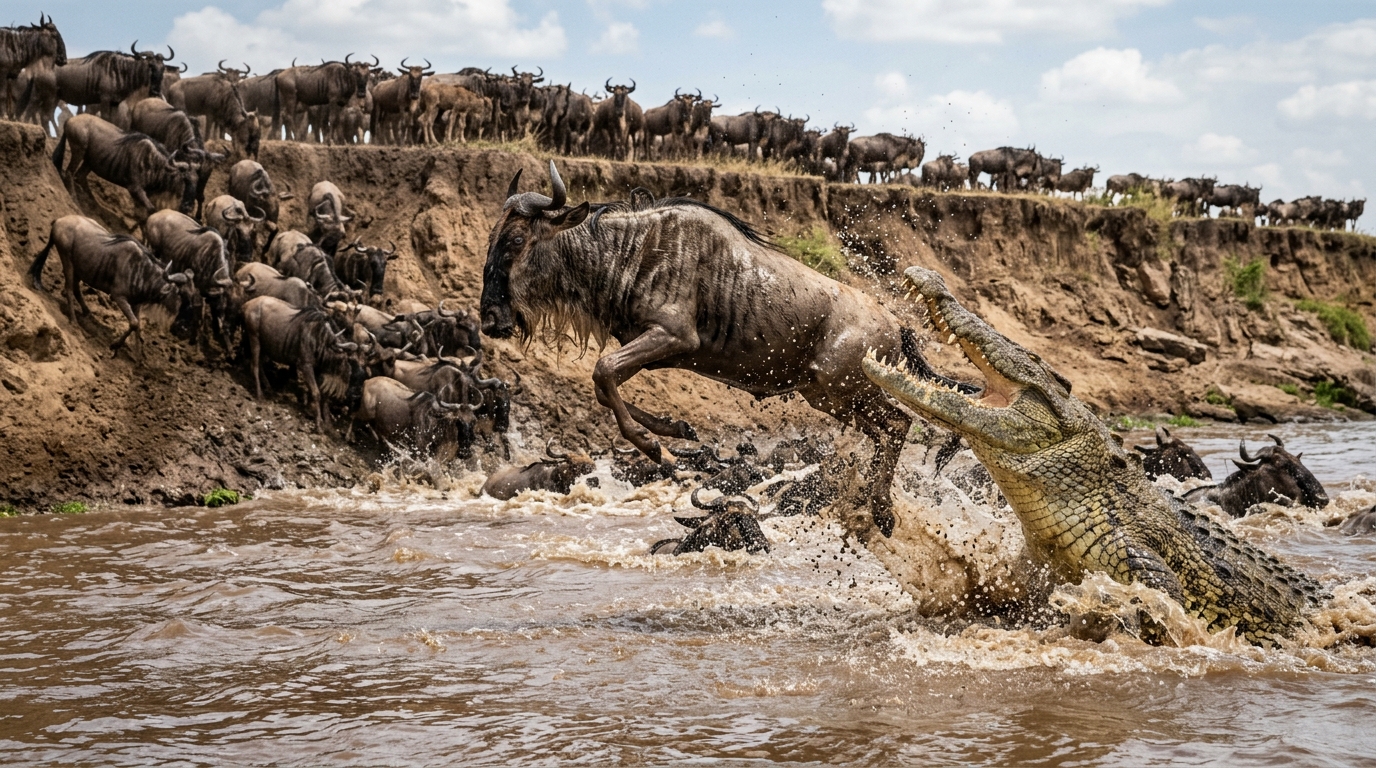
The Nile crocodiles in the Mara and Grumeti Rivers, the lions, cheetahs, hyenas and wild dogs that follow the herds — these are not incidental to the migration. They are part of the same system, shaped by millions of years of co-evolution. The crossing is not a mistake the wildebeest make. It is something they are compelled to do, generation after generation, because the grass on the other side of the river is real.
The Complete 2026 Migration Calendar
| Month | Phase | Location | Country | What to Watch | Rating |
|---|---|---|---|---|---|
| January | Calving season begins | Ndutu, S. Serengeti | Tanzania | Births, predator hunts, first calves | ★★★★★ |
| February | Peak calving | Ndutu plains | Tanzania | 500,000 calves born, cheetah and lion action | ★★★★★ |
| March | Calving ends, herds massing | S. Serengeti / Ndutu | Tanzania | Massive herd density, calves strengthening | ★★★★☆ |
| April | Long rains — herds move NW | Central Serengeti | Tanzania | Herds in transit, lush green landscape | ★★★☆☆ |
| May | Moving toward western corridor | Central / W. Serengeti | Tanzania | Large herd gatherings, quieter season | ★★★☆☆ |
| June | Grumeti River crossings | Western Corridor | Tanzania | First river crossings of the year, few tourists | ★★★★☆ |
| July | Migration enters Kenya | Maasai Mara / N. Serengeti | Kenya / Tanzania | First Mara River crossings, excitement builds | ★★★★★ |
| August | Peak crossings | Maasai Mara | Kenya | Maximum crossing frequency and intensity | ★★★★★ |
| September | Crossings continue | Maasai Mara / N. Serengeti | Kenya / Tanzania | River crossings at high frequency, great action | ★★★★★ |
| October | Herds begin return south | Departing Maasai Mara | Kenya → Tanzania | Last crossings, herds thinning | ★★★★☆ |
| November | Short rains — herds in Tanzania | Central Serengeti | Tanzania | Quieter, lush landscape, good general game | ★★★☆☆ |
| December | Return to southern Serengeti | S. Serengeti / Ndutu | Tanzania | Herds arriving, cycle resetting | ★★★★☆ |
Phase 1: January–March — The Calving Season
The most underrated phase of the Great Migration — and one of the most extraordinary wildlife events on earth.
Between late January and mid-March, the wildebeest herds converge on the short-grass plains of the southern Serengeti, centred on the Ndutu area near the Tanzania-Kenya border. This is where up to 500,000 wildebeest calves are born within a compressed 2 to 4-week window.
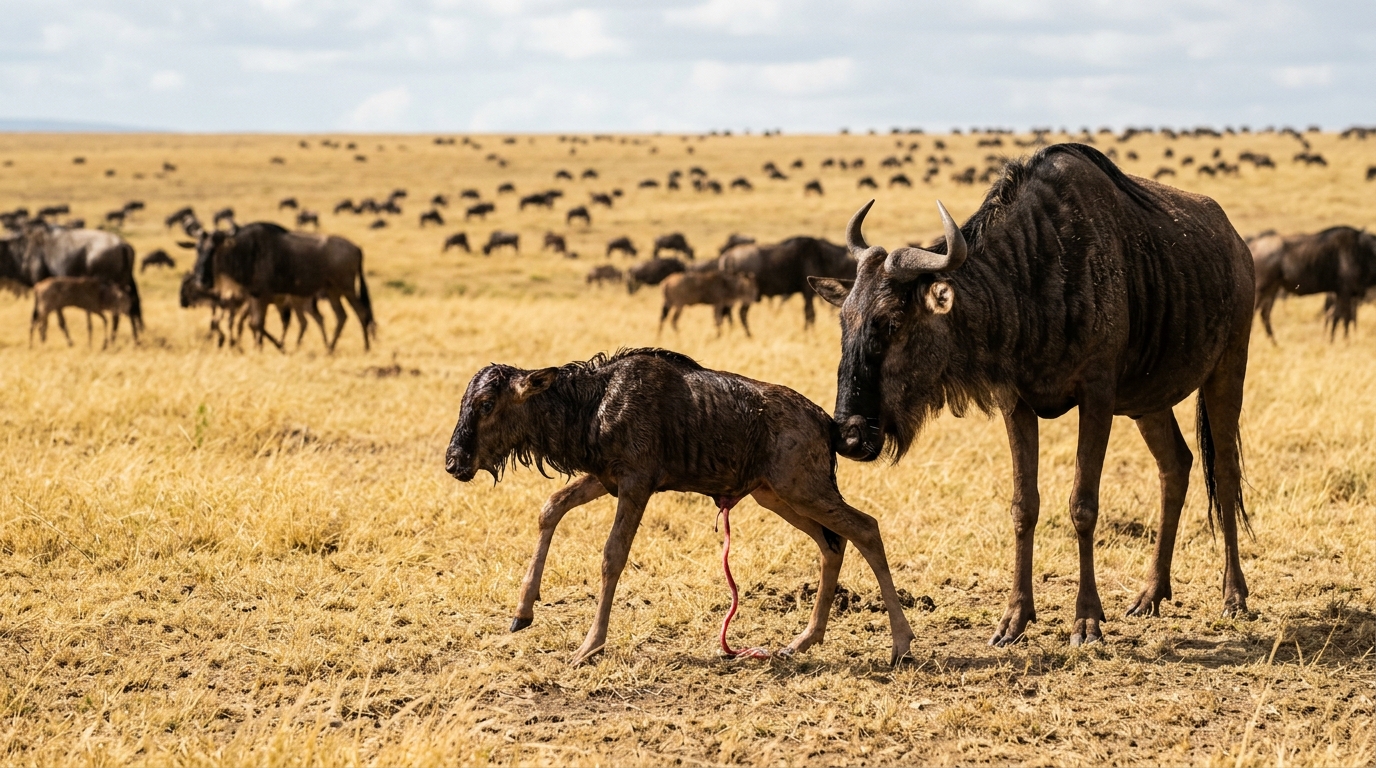
The evolutionary reasoning behind synchronised calving is brutal mathematics. If all calves are born within the same short period, predator populations — which remain relatively stable — are overwhelmed by sheer numbers. The vast majority of calves survive simply because there are too many for the lions, cheetahs, hyenas, and wild dogs to take. A calf born alone in October would be taken within an hour.
What this creates for the safari visitor is the most intense predator-prey activity in the Serengeti calendar. Cheetah mothers with cubs are hunting constantly. Lion prides coordinate attacks on the densely packed herds. Wild dog packs run at full stretch. And between the hunts, the plains are dotted with newborn wildebeest — some hours old, some minutes — taking their first unsteady steps in the early morning sun.
A calf that cannot stand within 7 minutes of birth will not survive. A calf that cannot run within an hour will not survive. Those that do are among the toughest animals on earth.
This phase is exclusively Tanzanian. If you visit the Maasai Mara in January or February, the wildebeest are not there. They are 300 kilometers south, on the Ndutu plains, being born.
Phase 2: April–May — The Long Rains Migration
As the long rains begin in April, the calving herds start breaking up and moving northwest through the central Serengeti. This is the quietest phase of the migration — the massive herd is dispersed across a large area, and the dramatic set-pieces of the calving and crossing seasons have not yet begun.
It is, however, a rewarding time to be in the Serengeti. The landscape is emerald green after the rains. Accommodation prices are significantly lower. And the general game viewing — resident lions, leopards, cheetahs, and the increasing zebra herds preceding the main wildebeest movement — is genuinely excellent.
The herds are on the move. They just have not concentrated for the drama yet.
Phase 3: May–July — Grumeti River Crossings
By late May and into June, the advance herds have reached the Western Corridor of the Serengeti and the Grumeti River — the first river obstacle of the annual cycle. These crossings are almost completely unknown outside Tanzania, because almost no one writes about them. The Grumeti crossings are smaller in scale than the Mara crossings ,the Grumeti crocodiles are fewer but they are crossing events, with everything that entails.
By late June, the leading herds have moved past the Grumeti and are reaching the Northern Serengeti. The first scouts cross into Kenya in early July. The river crossings calendar is beginning.
Phase 4: July–October — The Mara River Crossings
This is the phase the world knows. This is what fills the calendars of tour operators and the front pages of wildlife magazines every year from July through October.
July — The Arrival
The first significant herds enter Kenya’s Maasai Mara in early to mid-July. The initial Mara River crossing attempts begin — tentative, often aborted, occasionally breaking into full-scale events. July is exciting for anyone who understands what is coming, but unpredictable on any given day.
August — Peak Crossings
August is the migration at its most intense. The herds are fully in Kenya. The Mara River crossings are happening at their greatest frequency — multiple events per day at peak. The noise, the dust, the crocodiles, the wildebeest mid-river — this is the image that defines the migration, and in August it is happening in front of you.
August is also the most crowded month. Vehicle numbers at major crossing points reach 20 to 30 at peak events. Private conservancy stays or the Northern Serengeti side dramatically reduce this.
September — The Crossings Continue
September replicates August’s spectacle with marginally lower visitor numbers and the possibility of the first light rains arriving in the last week of the month. Many experienced guides consider September the best crossing month — the events are as frequent as August but the crowds have eased slightly.
October — The Return Begins
The short rains begin to arrive in Tanzania in October, triggering the herds’ southward return. The Mara River crossings continue through most of October — now in reverse, with herds crossing from Kenya back into Tanzania. The frequency reduces through the month as the herds thin. Late October is good value: crossings are still possible, accommodation costs are falling, and the Mara’s resident wildlife remains excellent.
Phase 5: November–December — The Return South
By November, the bulk of the herds are back in Tanzania, moving through the central Serengeti under the short rains. December sees them completing the return to the southern Serengeti, where the cycle begins again. December is an excellent month for general Serengeti and Mara game viewing — the landscape is lush, accommodation prices are reasonable (outside the Christmas and New Year window), and the south is beginning to receive the advance scouts of the migration for the upcoming calving season.
Where to Watch the Migration — Kenya vs Tanzania
| Phase | Best Country | Location | Why |
|---|---|---|---|
| Calving season (Jan–Mar) | Tanzania | Ndutu, Southern Serengeti | Only location for this phase |
| Grumeti crossings (May–Jun) | Tanzania | Western Corridor | Exclusive to Tanzania side |
| Mara River crossings (Jul–Oct) | Both | Mara (Kenya) or N. Serengeti (Tanzania) | Kenya: easier access; Tanzania: fewer vehicles |
| Return south (Nov–Dec) | Tanzania | Central and Southern Serengeti | Herds back in Tanzania |
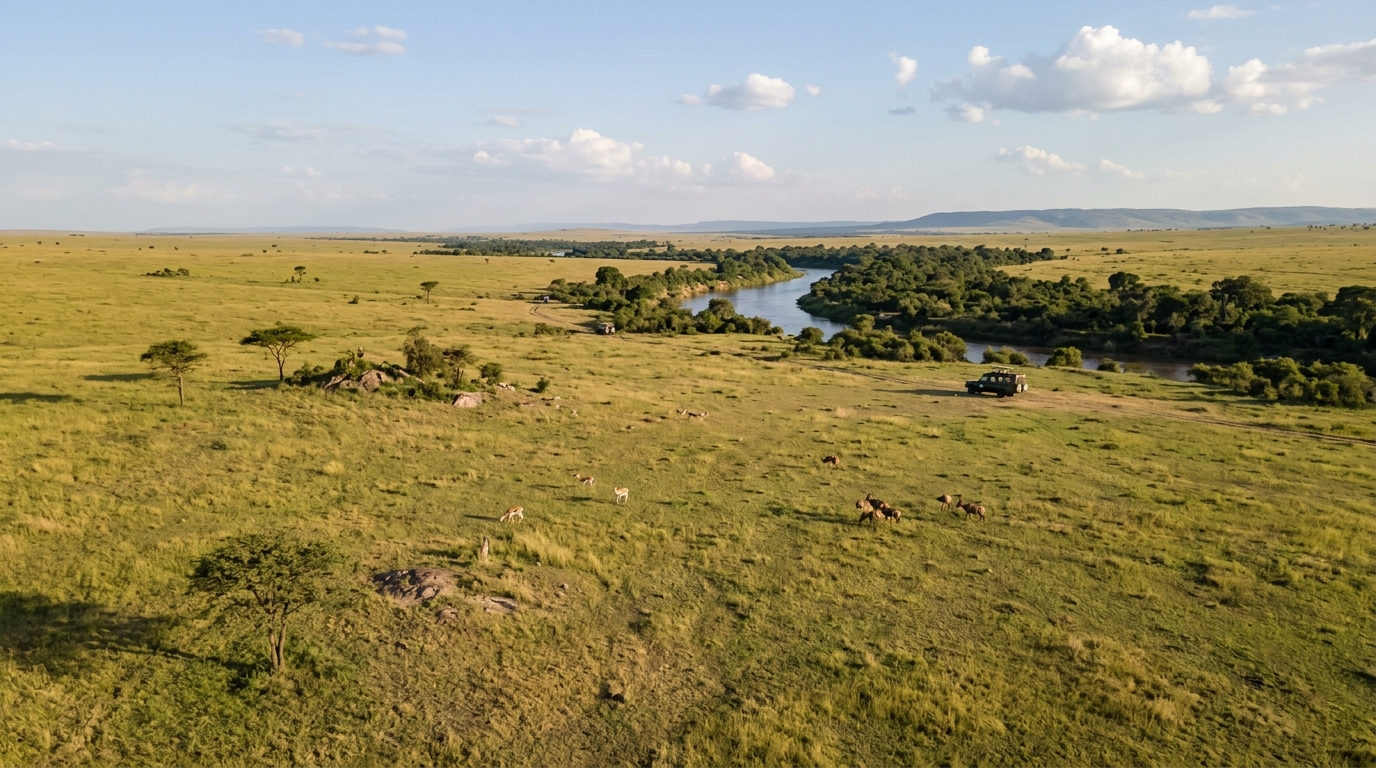
The Northern Serengeti advantage: The Kogatende area and Lamai Wedge in northern Tanzania offer the same Mara River crossings as the Kenyan side — but with a fraction of the vehicle density. Getting there requires a domestic flight from Arusha (45 minutes) or a long road transfer, which is precisely why most visitors do not go. Those who do find the crossing experience profoundly more intimate.
The River Crossings Explained — What Actually Happens
Why Do the Crossings Happen?
The grass on the north bank of the Mara River is genuinely greener — or more specifically, it is ungrazed and therefore fresher than the south bank the herd has already depleted. The wildebeest smell it and are compelled to cross. Evolution has programmed them to make this journey whether they individually survive it or not.
The Crossing Points
Guides in the Mara track crossing activity daily and radio updates between themselves. Key watched locations include:
- Crossing Point 1 (inside the reserve, near Mara Serena): The most reliable and accessible crossing point for most camps
- Crossing Point 5 (Lower Mara, near the Tanzania Triangle): More remote, excellent for photography
- Lookout Hill: An elevated viewpoint above a Mara River bend that gives panoramic views of herd movement and approach — outstanding for understanding the scale of what is unfolding below you.
Why Don’t They Just Cross?
A herd of 10,000 wildebeest can arrive at a riverbank, mill nervously for 4 to 6 hours, and then leave without crossing. The crossing decision appears to require a single animal to commit — a “pioneer” that breaks from the bank and enters the water. Until that moment, the collective anxiety of the herd prevents the decision.
When the crossing begins, it typically builds from that single animal into a torrent within minutes. Thousands of animals follow. The noise — hooves on rock, splashing, calls — is audible from half a kilometre away.
Can You Guarantee Seeing a Crossing?
No. Crossings cannot be predicted with certainty even hours ahead. Guides read the herd position and crossing-point activity, but the individual decision to cross is made by wildebeest, not humans.
Three nights in the Mara or Northern Serengeti during August or September gives a high probability of witnessing at least one crossing event. One night gives no reliable expectation.
Planning Your Migration Safari with Crescent Shores Retreats
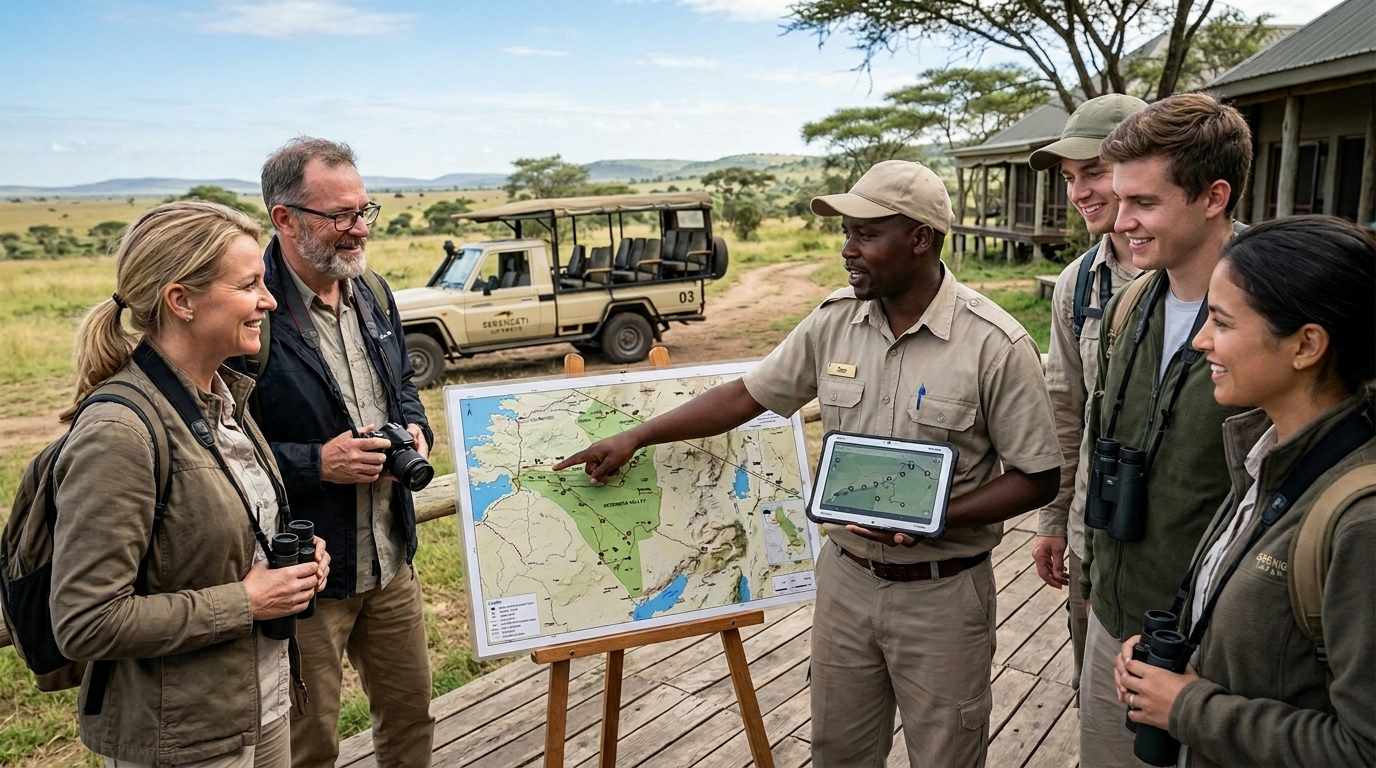
We monitor migration position in real time from our Naivasha base and brief clients on current herd locations and crossing activity in the two weeks before their arrival. This local intelligence — unavailable from any operator not physically present in the region — allows us to position clients optimally for the phase that is active during their travel dates.
📞 WhatsApp or call: +254 790 292 838 📧 Email: welcome@crescentshoresretreats.com 🌐 Maasai Mara Guide: The Definitive Maasai Mara Safari Guide → 🌐 Tanzania Safari Guide: Serengeti, Ngorongoro & Beyond → 🌐 Best time to visit: Maasai Mara Month-by-Month Guide → 🌐 Plan your safari: Contact Our Team →
Frequently Asked Questions — Wildebeest Migration 2026
When is the Great Wildebeest Migration?
The Great Wildebeest Migration is a year-round event — it does not have a single start or end date. The migration cycle runs continuously: calving season in the Southern Serengeti (January–March), movement north through the Serengeti (April–June), Mara River crossings in Kenya and Northern Serengeti (July–October), and return south to Tanzania (November–December). What most people mean when they ask “when is the migration?” is the Mara River crossing season, which runs from July to October with August and September being the peak months.
What months are best for the Mara River crossings?
August and September are the peak months for Mara River crossings — the most frequent and most dramatic. July sees the first significant crossings as herds arrive from Tanzania. October has the last crossings before herds return south. For the most intense crossing season, book August or September at least 5 to 6 months in advance. For good crossings with lower prices and fewer tourists, consider late July or early October.
Is the wildebeest migration in Kenya or Tanzania?
Both. The migration is a continuous circuit crossing the Kenya-Tanzania border twice per year. The calving season (January–March) and most of the year occur in Tanzania’s Serengeti. The famous Mara River crossings (July–October) happen on both sides — the Maasai Mara (Kenya) side has more established viewing infrastructure, while the Northern Serengeti (Tanzania) side offers the same crossings with significantly fewer vehicles.
How many wildebeest are in the Great Migration?
Approximately 2 million wildebeest (Connochaetes taurinus) participate in the Great Migration, accompanied by around 250,000 zebra and 500,000 Thomson’s gazelle. The total migrating herbivore population is approximately 2.75 to 3 million animals. The wildebeest population in the Serengeti-Mara ecosystem has grown from under 250,000 in the 1960s to around 2 million today — a conservation success story linked directly to the protection of both the Serengeti and the Maasai Mara.
Can you guarantee seeing a Mara River crossing?
No — river crossings cannot be guaranteed on any specific day. Crossings are driven by the wildebeest’s own decision-making and cannot be predicted reliably more than a few hours ahead. However, three nights in the Maasai Mara or Northern Serengeti during August or September gives a high probability of witnessing at least one significant crossing event. Guides with local knowledge can position you correctly. Our Naivasha base allows us to provide real-time migration intelligence to clients in the 2 weeks before their arrival.
What is the calving season and when does it happen?
The calving season is the phase of the Great Migration when wildebeest calves are born — up to 500,000 calves within a 2 to 4-week window between late January and mid-March on the Ndutu plains of the Southern Serengeti in Tanzania. It is the most intense predator-prey activity period of the year and rivals the Mara River crossings as a wildlife spectacle. Unlike the crossings, the calving season is exclusively Tanzanian — there is no Kenyan equivalent. It is one of East Africa’s most underrated and underbooked wildlife experiences.
— Crescent Shores Retreats, Naivasha, Kenya Naivasha-based safari tour operator · Kenya · Tanzania · Uganda · Rwanda +254 790 292 838 · welcome@crescentshoresretreats.com



Leave A Comment