
By Crescent Shores Retreats · Naivasha, Kenya · Published October 2026 · 12 min read
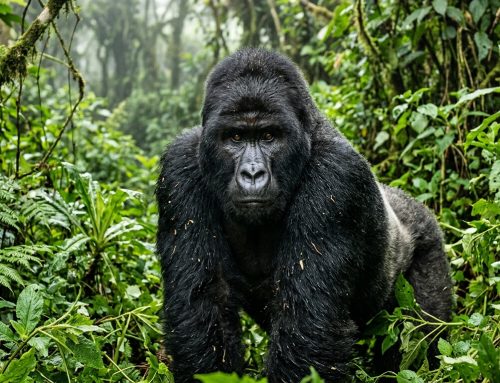
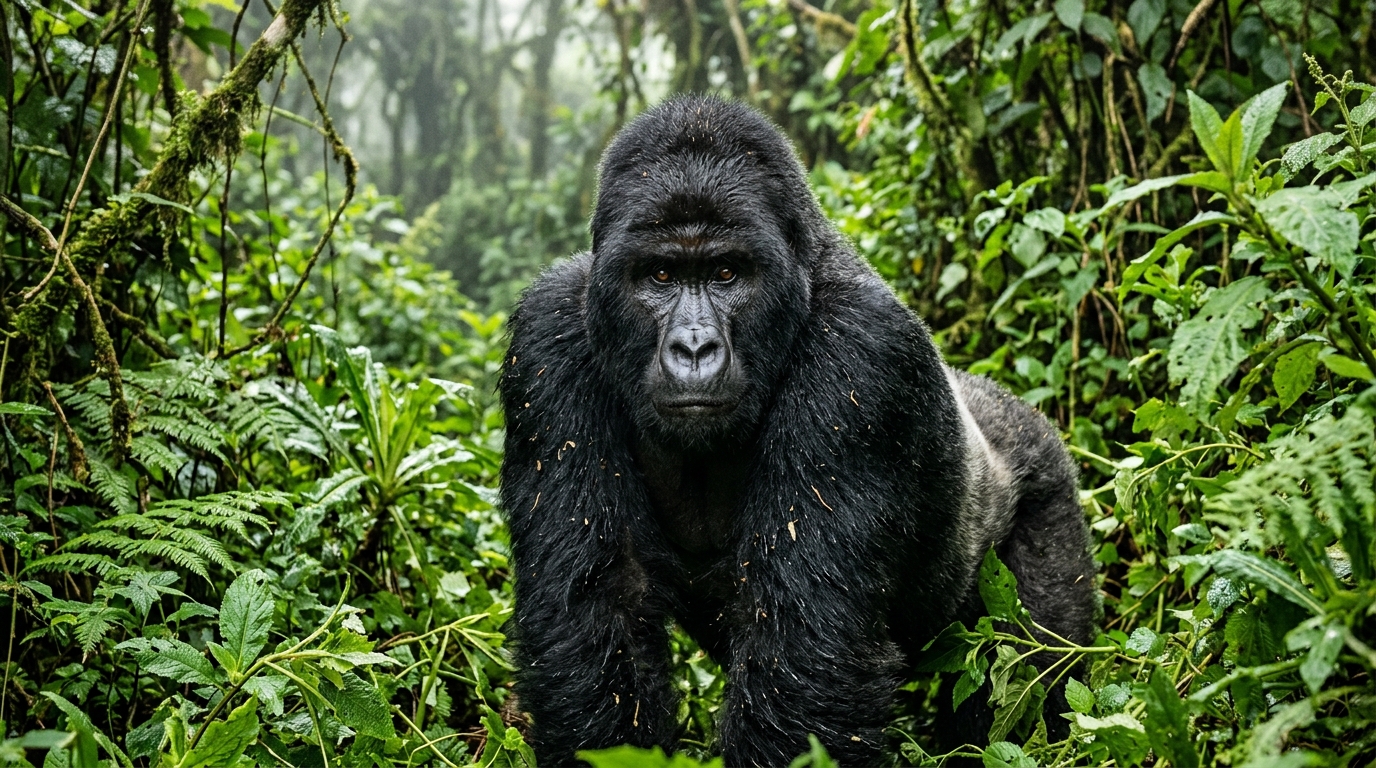
The gorilla trekking is the reason almost everyone comes. A USD $1,500 permit, an early morning briefing at Kinigi, and then two hours or so of climbing through a montane forest whose floor shifts unpredictably between bamboo stems and root tangles, before the guide stops, crouches, and a silverback materialises from the green twenty metres away.
That encounter is extraordinary. It is also one hour of a Rwanda trip that typically runs three to four days at the park. What fills the rest?
The golden monkeys — found only in the Virunga volcanoes, nowhere else on earth. The Dian Fossey tomb hike to Karisoke, where the woman who made gorilla conservation possible lived and worked for 18 years and was buried alongside the gorilla whose death she made the world care about. Bisoke’s crater lake at 3,711 metres, accessible as a day hike with an extraordinary summit reward. The Sabyinyo summit where three countries meet. And Kigali — two hours away — one of the most surprising cities in Africa.
This is the guide to all of it.
Volcanoes National Park at a Glance — Key Facts for 2026
The Six Virunga Volcanoes
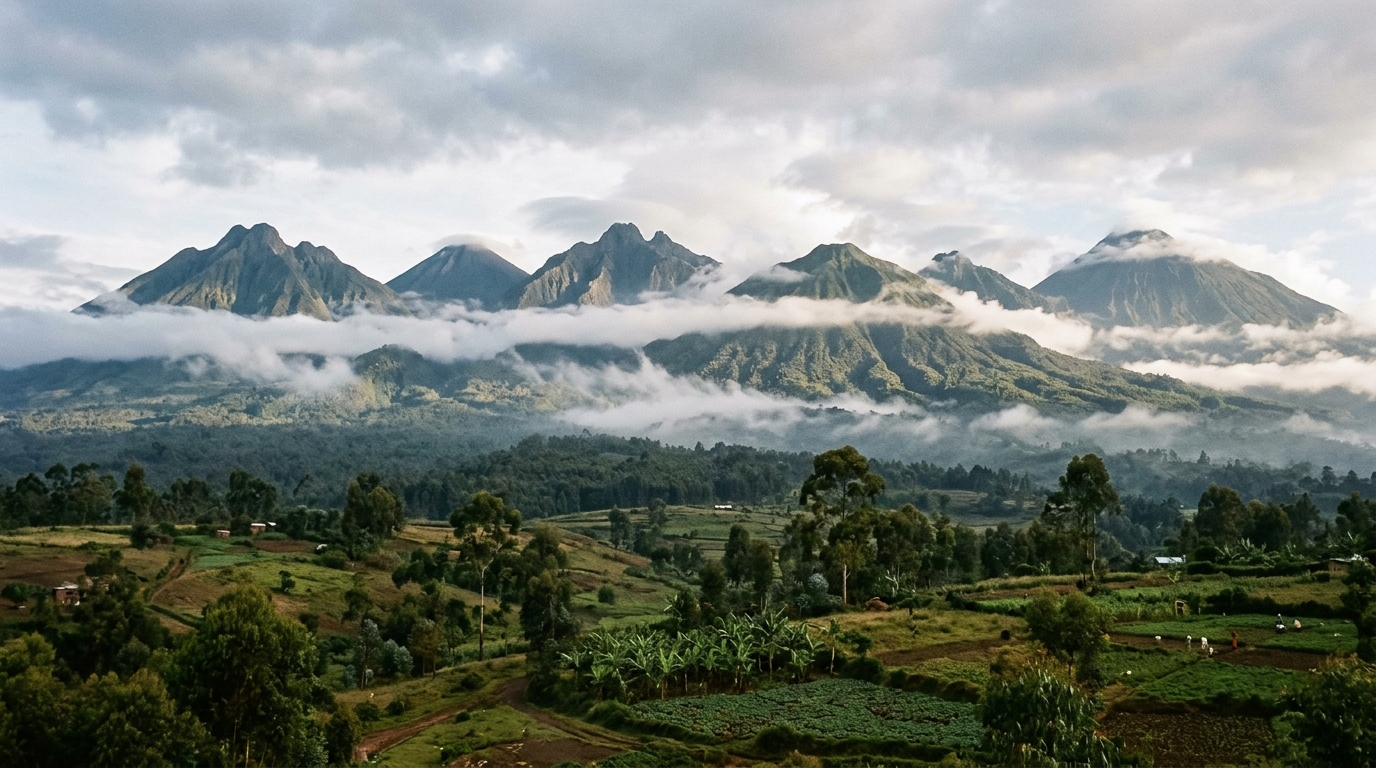
The park takes its name from the six volcanoes that define it. Each can be viewed from the park’s lower slopes and several are hikeable — alone, they would make Volcanoes National Park a compelling destination. Combined with the gorillas and the primates, they make it exceptional.
| Volcano | Height | Character | Hikeable? |
|---|---|---|---|
| Karisimbi | 4,507 m | Highest; dormant; snow possible at summit | Yes (2-day) |
| Bisoke | 3,711 m | Active; spectacular crater lake | Yes (1-day) |
| Muhabura | 4,127 m | Dormant; long day hike | Yes (challenging 1-day) |
| Gahinga | 3,474 m | Dormant; bamboo and forest | Yes (shorter hike) |
| Sabyinyo | 3,634 m | Dormant; tri-border summit | Yes (strenuous) |
| Visoke | 3,711 m | Same peak as Bisoke (spelling variant) | — |
The volcanoes are not static background scenery. They generate the park’s ecology — the altitude gradients create distinct vegetation zones (grassland, bamboo, Hagenia-Hypericum forest, ericaceous heath, afro-alpine moorland) that each support different species. The gorillas range across several of these zones; the golden monkeys are primarily found in the bamboo; Bisoke’s summit is a different world from the lower slopes.
The Gorillas — What Article 04 Covers in Full
Gorilla trekking in Volcanoes National Park is covered in complete detail in our Rwanda Gorilla Trekking Guide → — the permit structure, the 10 habituated families, the morning briefing at Kinigi, and the one-hour encounter format.
Here, a brief orientation: the park holds 10 habituated gorilla families with a maximum of 8 visitors per family per day. The most famous is the Susa group — the family studied by Dian Fossey herself, one of the largest and one of the most historically significant gorilla families in the world. The Sabyinyo group is often the easiest family to reach, ranging at lower altitudes near the park boundary. The Amahoro group (amahoro means “peace” in Kinyarwanda) is known for its calm temperament and size.
Golden Monkey Trekking — Volcanoes NP’s Second Jewel
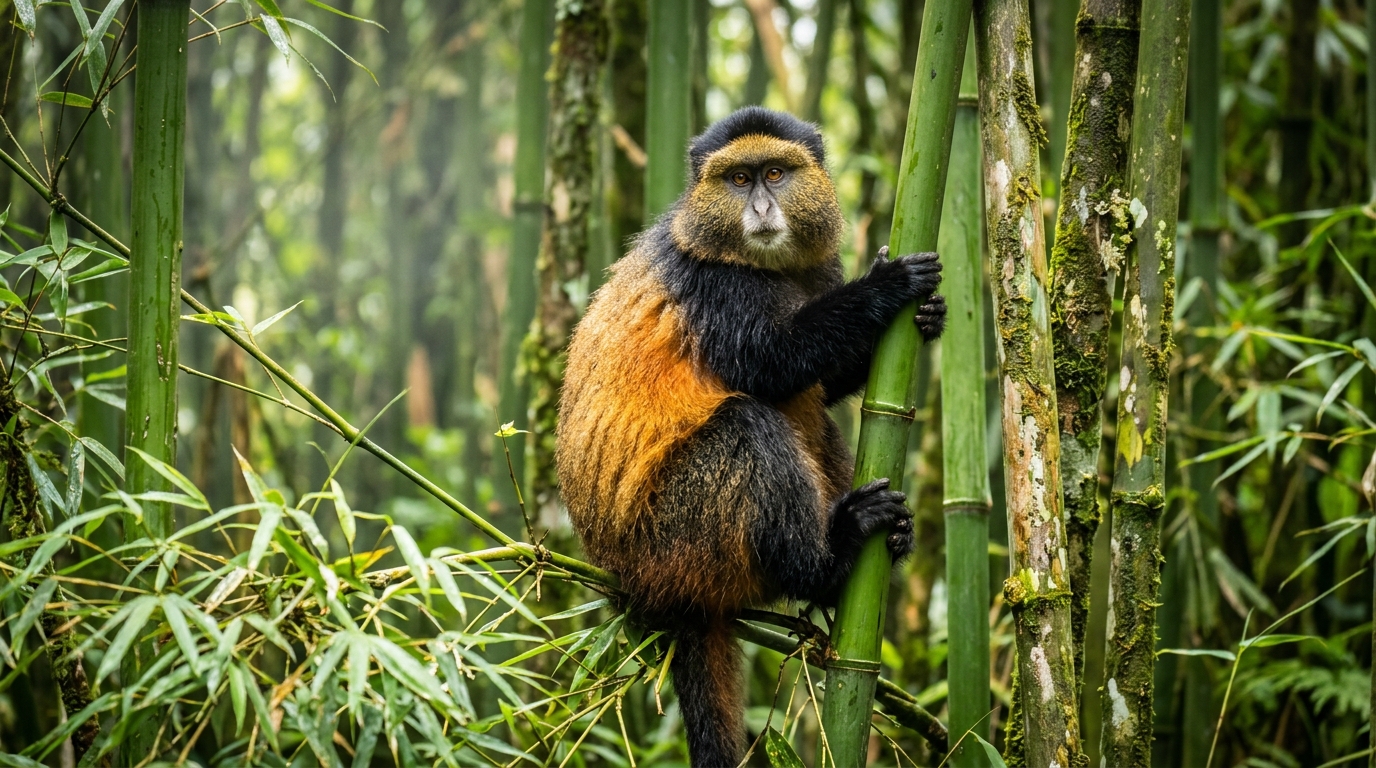
The golden monkey (Cercopithecus kandti) is found only in the Virunga Massif — Rwanda, Uganda’s Mgahinga Park, and the adjacent DRC. It exists nowhere else on earth. Volcanoes National Park has habituated golden monkey groups available for visitor trekking — the same format as gorilla trekking but at lower altitude, shorter duration, and a permit price of USD $100 per person.
The golden monkey’s colouration is genuinely remarkable: a vivid orange-gold patch extending across the back and flanks, set against black limbs, face, and crown. In the green-and-shadow light of the bamboo forest where they are most commonly found, the orange blazes.
The difference from gorilla trekking: The trek to reach a habituated golden monkey group is typically shorter and less strenuous than the gorilla trek — the bamboo zone sits at lower altitude than where most gorilla families range. The hour with the group has a different character too: golden monkeys are smaller, faster, and more active than gorillas, moving through the bamboo with a speed that demands attentive photography rather than the stillness that a gorilla encounter allows.
Practical combination: Most visitors do gorilla trekking on Day 1 and golden monkey trekking on Day 2. Park regulations do not permit the same visitor to do both activities on the same day — they depart at the same early morning time from Kinigi. Two nights near the park gives you both. Three nights gives you both plus a day for a volcano hike or the Fossey hike.
The Dian Fossey Tomb Hike — Karisoke
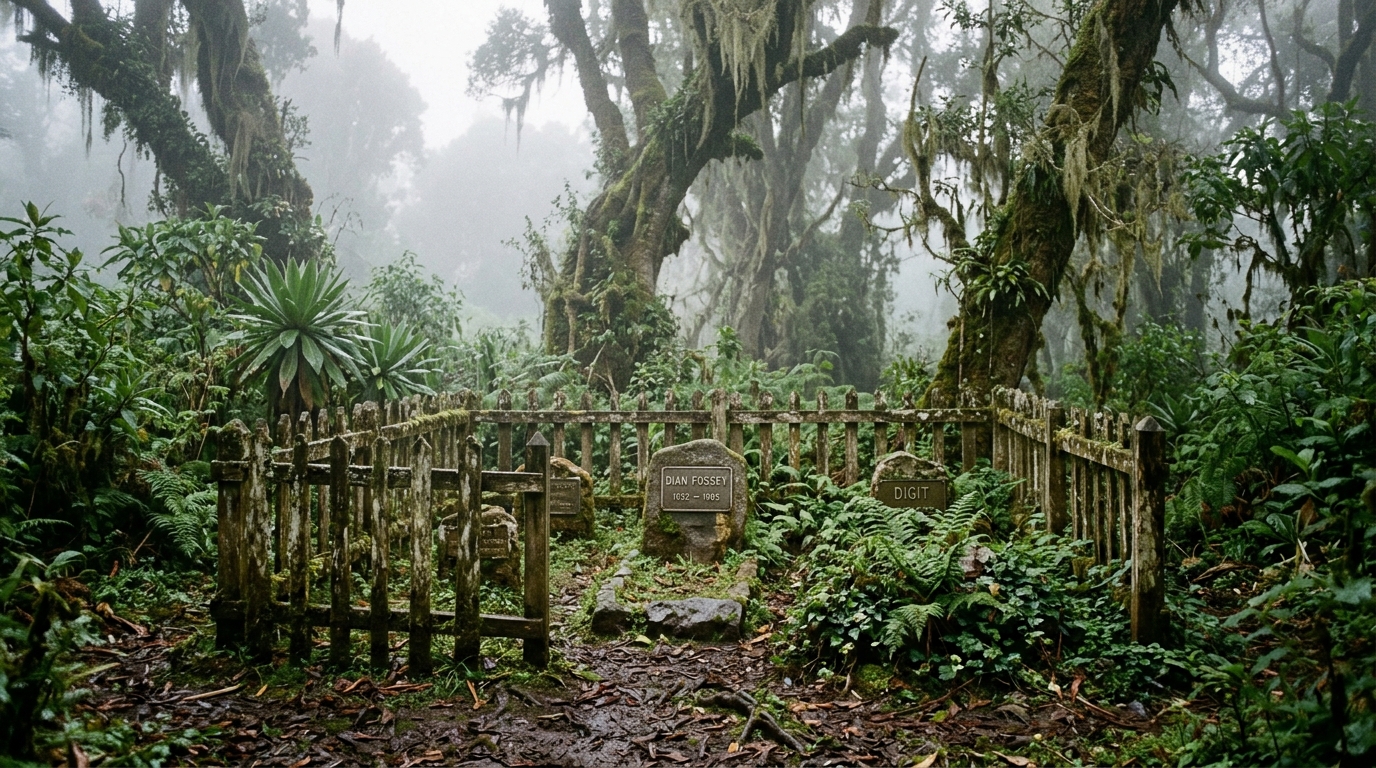
In 1967, a 35-year-old American zoologist set up a research station in a mountain saddle at approximately 3,000 metres between the volcanoes Bisoke and Karisimbi, and began what would become the world’s most important long-term study of a primate species. She called the station Karisoke — a combination of the two volcanoes’ names.
Dian Fossey spent 18 years at Karisoke. She named the gorilla families she studied and identified individuals. She published Gorillas in the Mist in 1983. She was murdered in her cabin on 26 December 1985, an unsolved crime that remains one of conservation history’s most disturbing events.
She is buried at Karisoke, alongside Digit — the young male gorilla killed by poachers in 1978, whose killing was the catalyst for the global conservation movement that ultimately saved the mountain gorilla from extinction. The Dian Fossey Gorilla Fund, which she founded before her death, continues to operate research at the site today.
The hike: From Kinigi headquarters, the trail climbs through the park’s montane forest for approximately 2 to 3 hours (round trip: 4 to 6 hours depending on pace). The path passes through several vegetation zones and reaches the original Karisoke camp location — now partially overgrown, with Fossey’s simple grave marker and Digit’s grave nearby.
This is not a conventional tourist attraction. It is a place of genuine historical weight — a spot where one person’s determination, and another animal’s death, changed the fate of an entire species. Visitors who approach it with that context find it deeply moving. Those who have read Gorillas in the Mist or seen the film will find it almost unbearably specific.
Bisoke Volcano Hike — Crater Lake at 3,711 Metres
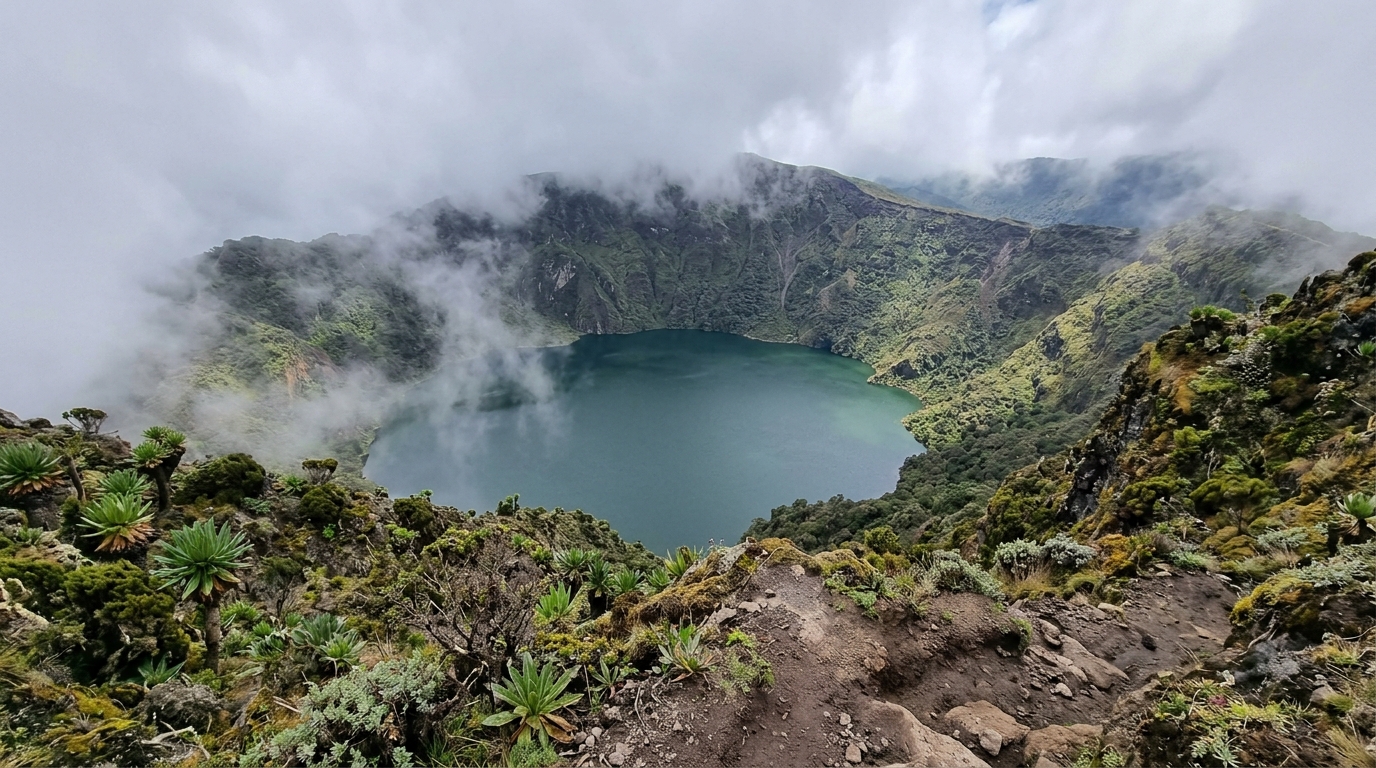
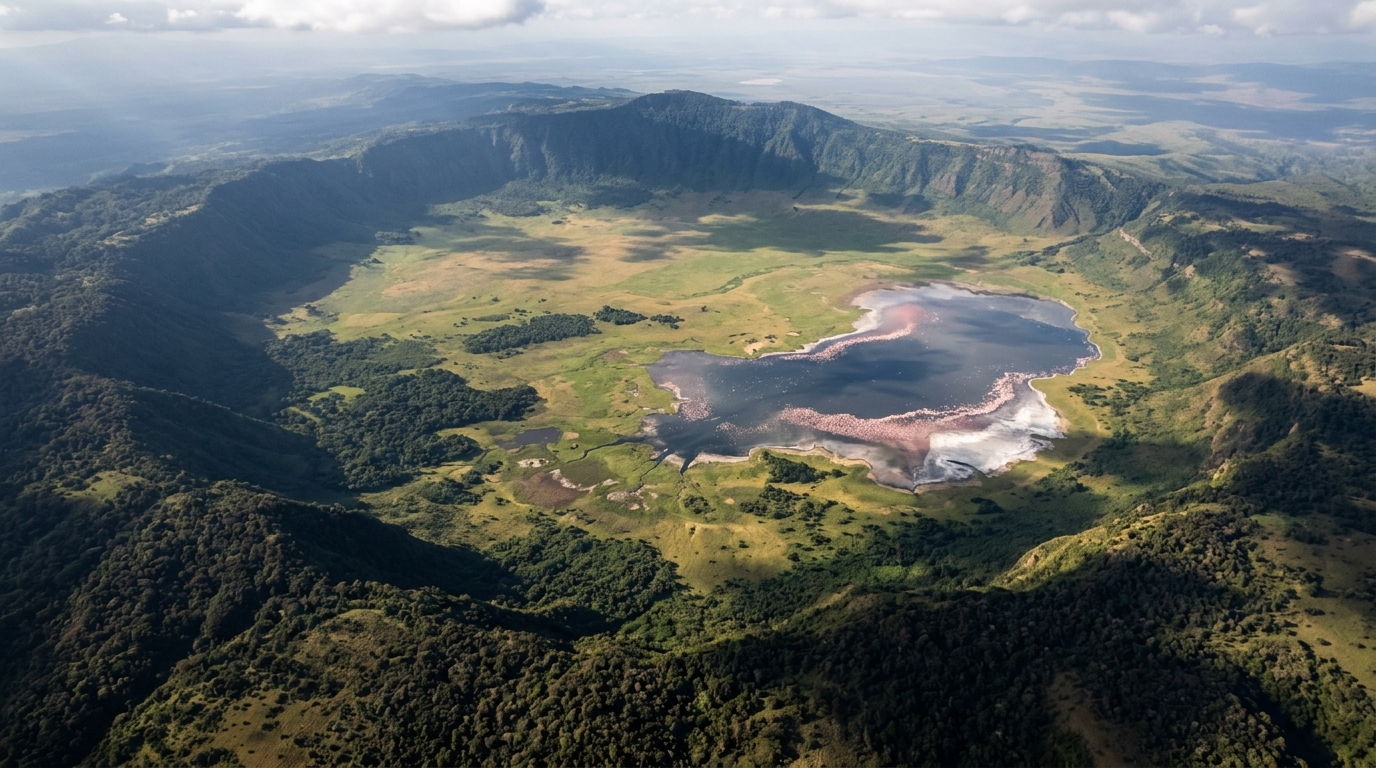
The Bisoke day hike is the most popular volcano hike in Volcanoes National Park and the most rewarding for the investment of effort required. The summit sits at 3,711 metres and holds a spectacular circular crater lake — an ancient volcanic vent now filled with still water, ringed by the crater rim, with views of the other Virunga volcanoes on clear days.
The hike: A guided ascent from the park headquarters takes approximately 3 to 4 hours to the summit and 2 hours for the descent — 5 to 7 hours total. The terrain transitions from farm boundary at the park edge through bamboo forest, Hagenia-Hypericum woodland, and ericaceous heath before emerging on the bare moorland of the upper slopes. The summit itself, when cloud allows, is extraordinary: a perfectly circular lake in the crater below and five other Virunga peaks visible in a line.
Difficulty: Bisoke is a strenuous hike requiring reasonable fitness and comfortable walking shoes with good grip. It is not technically difficult — no climbing equipment required — but the altitude gain (approximately 1,000 metres from the trailhead) and the sometimes muddy terrain make it demanding. Porters are available and recommended.
Best time: The dry seasons — June to September and December to February — offer the clearest summit conditions and the firmest trails. The rainy season produces lush and dramatic forest but obscured summit views and significantly muddier trails.
Karisimbi — The Two-Day Summit Ascent
Rwanda’s highest point at 4,507 metres — and the highest of the eight Virunga volcanoes — Karisimbi is a two-day ascent with an overnight camp at approximately 3,700 metres. Snow is possible at the summit. Clear days give views across the entire Virunga chain and into both Uganda and the DRC.
This is a hike for the physically prepared. The overnight camp is tent-based and cold — temperatures drop well below 0°C on the summit section. The day-two morning summit push, in the dark and cold with headtorches, is the most demanding part of any activity available in Volcanoes National Park. It is also, for the right visitor, among the most rewarding.
Booking: Available through Rwanda Development Board at the park headquarters. Porter and guide are compulsory. All camping equipment is provided. Altitude acclimatisation is important — visitors arriving directly from sea level should allow a day at Kinigi (1,800 metres) before attempting the ascent.
Sabyinyo — Standing on Three Countries
The Sabyinyo summit (3,634 metres) holds a distinction unique among Rwanda’s highlands: the peak sits at the tri-border junction of Rwanda, Uganda, and the Democratic Republic of Congo. Standing at the summit, you can step from one country to another with a single stride.
The hike is approximately 6 to 8 hours return — strenuous, involving some near-vertical sections with fixed ropes on the upper approaches, but achieving a summit that is simultaneously the most interesting political geography and one of the best panoramic positions in the Virungas. The views extend across all six volcanoes and into the broader Albertine Rift.
Kigali — The City Worth Including
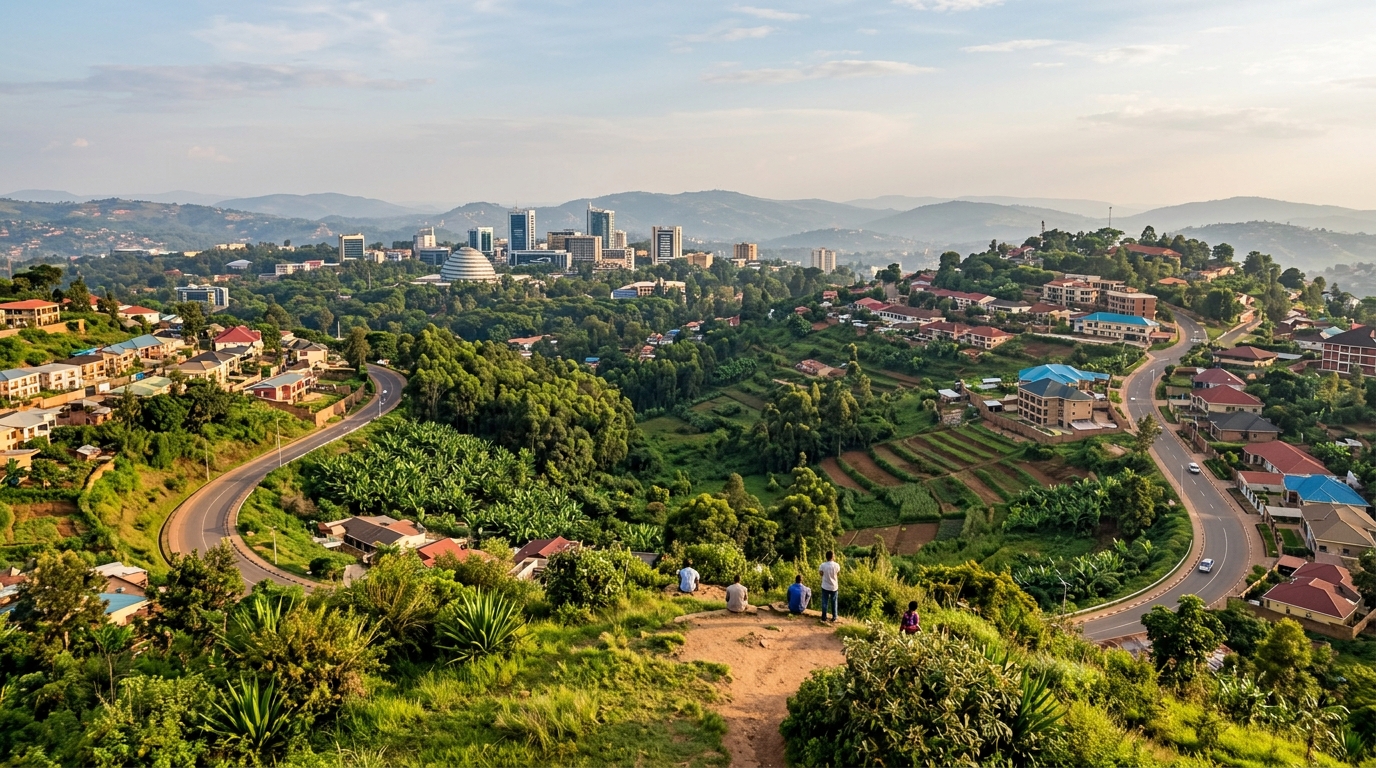
Two hours from Volcanoes National Park, Rwanda’s capital Kigali is consistently ranked as Africa’s cleanest and most orderly city. For most gorilla trekking visitors, it is the arrival and departure point. For those who allow one or two extra nights, it is a city that rewards curiosity and confounds expectations.
The Kigali Genocide Memorial
The most important site in the city and one of the most important memorial sites in modern history. The Genocide Memorial documents the 1994 Rwandan genocide — 100 days in which approximately 800,000 Tutsi civilians were killed — with a seriousness and clarity that makes it genuinely essential context for understanding Rwanda’s extraordinary recovery. This is not an easy visit. It is an important one.
The City
Beyond the memorial: the Kimironko market for local craft and fresh produce; the Inema Arts Center for contemporary Rwandan art; excellent restaurants in Kiyovu and Nyarutarama serving Rwandan, Pan-African, and international cuisine at a quality that frequently surprises visitors who did not expect much from the Rwandan capital.
Kigali’s famously clean streets, efficient transport, and low petty crime are the visible results of deliberate national policy — including the Umuganda monthly community cleaning day and the nationwide plastic bag ban implemented in 2008. Walking in Kigali feels materially different from walking in most African capitals, and in a way that is immediately apparent and consistently noted.
Accommodation Near Volcanoes National Park
The park’s proximity to Kigali and its premium gorilla permit price have attracted some of Africa’s finest safari accommodation to the Kinigi area. Several properties regularly appear on global best-of lists and can charge accordingly.
Premium tier: Singita Kwitonda Lodge, Bisate Lodge (Wilderness Safaris), One&Only Gorilla’s Nest, and Sabyinyo Silverback Lodge represent the highest level of Rwanda accommodation. Rates typically range from USD $800 to $2,500 per person per night at these properties. They are extraordinary in their design, setting, and service quality.
Mid-range: Mountain Gorilla View Lodge and several other well-established properties around the Kinigi area offer comfortable accommodation with good service and park access at rates of USD $200 to $600 per person per night — still expensive by global standards but significantly below the top tier.
Musanze/Ruhengeri: The nearest town (12 km from Kinigi) has basic to comfortable guesthouses for budget-conscious visitors who want to keep accommodation costs to a minimum while prioritising the gorilla permit.
Best Time to Visit
Gorilla trekking: Year-round. Mountain gorillas are resident in the park regardless of season. The June to September and December to February dry seasons offer drier trails and, sometimes, better gorilla photography conditions with less dripping forest. The March to May and October to November wet seasons produce lush, atmospheric forest conditions and lower visitor numbers.
Volcano hikes: Dry season is considerably preferable — the trails are firmer, the summit views are more likely to be clear, and Bisoke’s crater lake is more likely to be visible. Wet season volcano hiking is possible but involves more mud, more cloud cover, and potentially obscured summit views.
Getting to Volcanoes National Park from Nairobi
By air: Fly from Nairobi JKIA to Kigali International Airport (approximately 1 hour 20 minutes) on RwandAir, Kenya Airways, or other carriers. From Kigali, private road transfer to Kinigi takes approximately 2 to 2.5 hours via Musanze.
Total time from leaving Nairobi to reaching your Kinigi lodge: approximately 4 to 5 hours.
This is Rwanda’s compelling access advantage over Uganda — Bwindi requires 7 to 10 hours of travel from Entebbe; Volcanoes NP requires 4 to 5 hours from Nairobi. For travellers combining Rwanda with Kenya, the logistics are clean: fly Nairobi to Kigali, 2 nights at the park (gorilla trek + golden monkeys or Fossey hike), 1 night Kigali, return to Nairobi.
Crescent Shores coordinates the full Rwanda itinerary from Nairobi as a single package — flights, transfers, RDB permit acquisition, accommodation, and guide services.
Plan Your Rwanda Volcanoes Safari with Crescent Shores Retreats
📞 WhatsApp or call: +254 790 292 838 📧 Email: welcome@crescentshoresretreats.com 🌐 Full Rwanda gorilla guide: Rwanda Gorilla Trekking: Everything You Need to Know → 🌐 Uganda vs Rwanda comparison: Uganda vs Rwanda Gorilla Trekking → 🌐 Build your itinerary: Contact Our Team →
Frequently Asked Questions — Volcanoes National Park Rwanda
What else can you do in Volcanoes National Park besides gorilla trekking?
Beyond gorilla trekking, Volcanoes National Park offers: golden monkey trekking (USD $100, the only place in the world to see this species); the Dian Fossey tomb hike to the original Karisoke Research Center (2–3 hours each way); the Bisoke volcano day hike to a crater lake at 3,711 metres; the Karisimbi 2-day summit ascent to Rwanda’s highest point (4,507 m); and the Sabyinyo summit hike to the tri-border junction of Rwanda, Uganda and DRC. Two nights at the park with one gorilla trek day gives time for one or two of these additional activities.
What is golden monkey trekking in Volcanoes National Park?
Golden monkey trekking is a guided visit to a habituated group of golden monkeys (Cercopithecus kandti) in the bamboo forest zone of Volcanoes National Park. The golden monkey — distinctive for its vivid orange-gold back patch against black limbs — is found only in the Virunga Volcanoes and has no other range on earth. The permit costs USD $100 per person. The trek format mirrors gorilla trekking (guided walk to find the group, one hour with the animals) but is typically shorter and at lower altitude. Park regulations do not permit gorilla and golden monkey trekking on the same day — they both depart at the same early morning time.
How long is the Dian Fossey tomb hike to Karisoke?
The Dian Fossey tomb hike from Kinigi park headquarters to the original Karisoke Research Center takes approximately 2 to 3 hours each way — a 4 to 6-hour round trip depending on pace. The trail climbs through montane forest and reaches the camp location where Fossey lived, worked, and was buried alongside Digit, the gorilla whose poaching death became a catalyst for the global conservation movement. A guide and park fees apply. This is one of the most emotionally significant hikes available in any East African national park.
Is it worth doing the Bisoke volcano hike in Volcanoes National Park?
Yes — the Bisoke day hike is the most rewarding of the Volcanoes NP volcano hikes for the time investment required. The 5 to 7-hour guided return ascent to 3,711 metres reaches a spectacular circular crater lake at the summit and (on clear days) views of the other Virunga volcanoes. It is strenuous but achievable without technical climbing experience. Best done in the dry season (June–September or December–February) for clearer summit conditions. Porters are available and recommended.
How do I get to Volcanoes National Park from Nairobi?
Fly from Nairobi JKIA to Kigali International Airport (approximately 1 hour 20 minutes) on RwandAir, Kenya Airways or Ethiopian Airlines. From Kigali, private road transfer to the park headquarters at Kinigi takes approximately 2 to 2.5 hours via Musanze. Total journey time from Nairobi: approximately 4 to 5 hours. Crescent Shores Retreats coordinates the full routing — flights, Kigali transfer, RDB gorilla permit acquisition, and Kinigi accommodation — as a single package.
How long should I spend in Volcanoes National Park?
Two nights minimum for gorilla trekking plus one additional activity (golden monkey or Fossey hike). Three nights to add a volcano hike (Bisoke) alongside the gorilla trek and one other activity. Four nights for the most complete experience — gorilla trek, golden monkeys, Fossey hike, and Bisoke — without feeling rushed. Add one night in Kigali before or after for the city experience and the Genocide Memorial, giving a total of 3 to 5 nights in Rwanda as a meaningful standalone itinerary or Kenya-Rwanda combination.
— Crescent Shores Retreats, Naivasha, Kenya Naivasha-based safari tour operator · Kenya · Tanzania · Uganda · Rwanda +254 790 292 838 · welcome@crescentshoresretreats.com

Leave A Comment