
By Crescent Shores Retreats · Naivasha, Kenya · Published May 2026 · 13 min read
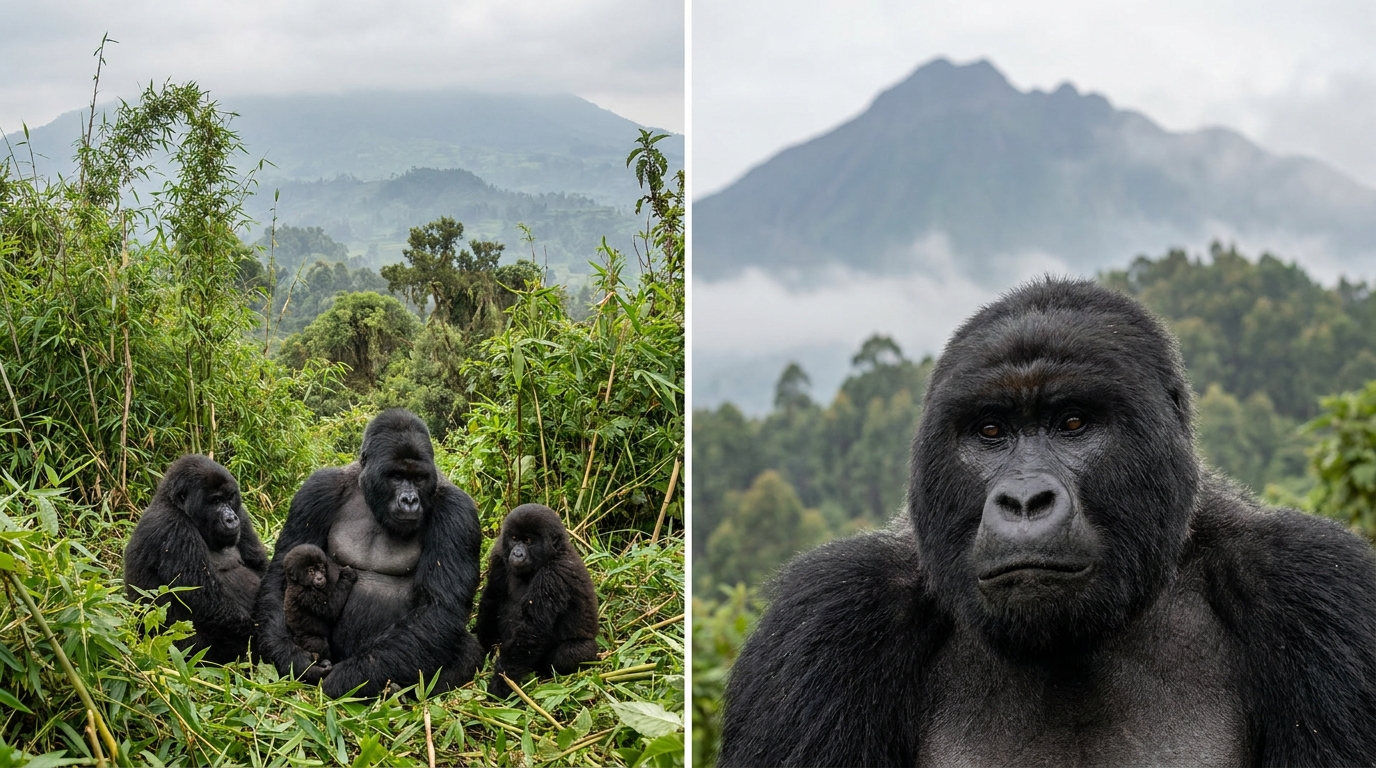
In 1967, an American zoologist named Dian Fossey set up a research camp in the volcanic mountains of northwestern Rwanda and began the work that would eventually save a species. She called the place Karisoke. She spent 18 years studying the mountain gorillas of the Virunga Massif — living among them, naming them, recording their family structures — until her murder in 1985, still unsolved. Her book, Gorillas in the Mist, made the mountain gorilla known to the world. Her legacy made Rwanda the most celebrated gorilla trekking destination on earth.
Today, Volcanoes National Park in Rwanda protects ten habituated gorilla families — descendants of the same animals Fossey studied. It sits two hours from Kigali, flanked by six ancient volcanoes, in a forest where bamboo gives way to Hagenia trees and mist clings to the slopes at every hour of the day. The gorilla trekking permit costs USD $1,500 per person — the most expensive single wildlife experience on earth — and is, by every measure, worth every cent.
This is your complete guide to Rwanda gorilla trekking in 2026.
Why Rwanda Is the World’s Premier Gorilla Trekking Destination
Rwanda and Uganda share the same mountain gorillas — the animals do not know or care about international borders. The experience of spending one hour with a habituated gorilla family is, at its core, the same in both countries. But Rwanda brings a specific combination of factors that make it the choice for a growing number of travellers.
Accessibility. Volcanoes National Park is just 2 hours from Kigali International Airport by road. You land in Rwanda, spend a night in Kigali, and the following morning you are standing at the trailhead. No domestic flights, no 7-hour overland drives. For travellers with limited time or those combining Rwanda with other destinations, this is a decisive advantage.
Infrastructure and polish. Rwanda has invested heavily in its tourism infrastructure over the past two decades. The roads to Volcanoes National Park are well maintained. The park headquarters at Kinigi is professional and well organised. The luxury lodges surrounding the park — several of them regularly ranked among the top safari lodges on earth — offer a level of comfort and service that matches or exceeds anything in East Africa.
Conservation legacy. Rwanda is the birthplace of mountain gorilla conservation. Dian Fossey’s Karisoke Research Center continues to operate in the park. The Rwanda Development Board has built one of Africa’s most respected wildlife management programmes around gorilla protection. When you buy a Rwanda permit, you are supporting a conservation model that the world watches and studies.
The complete package. Volcanoes National Park offers not only gorilla trekking but also golden monkey trekking, volcano hikes to the summits of Bisoke and Karisimbi, and the Dian Fossey tomb hike to Karisoke itself. Rwanda beyond the park adds Akagera National Park for a Big Five safari and Nyungwe Forest for chimpanzees. A Rwanda-only itinerary of 5 to 7 days is genuinely complete.
Volcanoes National Park — Rwanda’s Gorilla Country
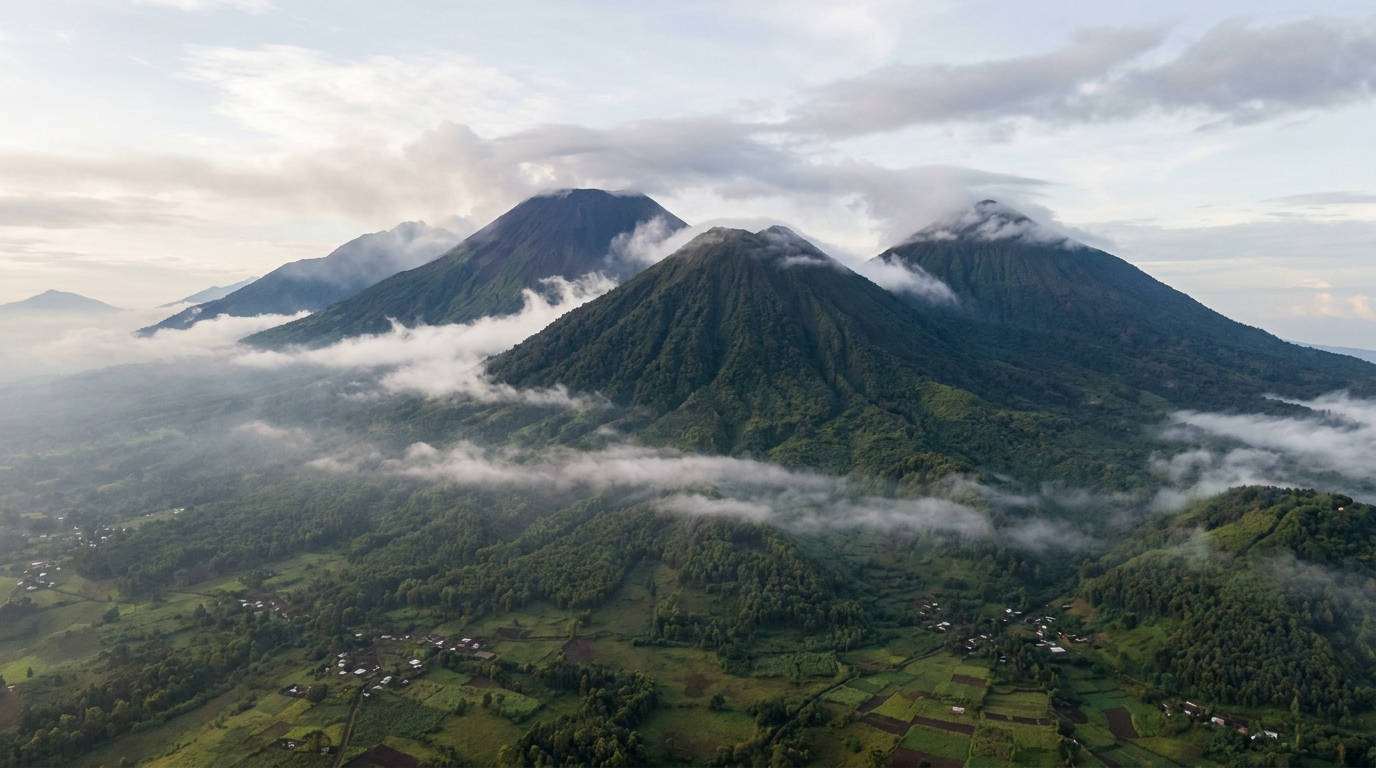
Volcanoes National Park covers 160 square kilometres in Rwanda’s northwestern corner, forming Rwanda’s section of the Virunga Conservation Area — a transboundary ecosystem shared with Uganda’s Mgahinga Gorilla National Park and the DRC’s Virunga National Park.
The park is named for the eight Virunga volcanoes that define its landscape. Six of these lie within Rwanda or on its border:
| Volcano | Height | Status |
|---|---|---|
| Karisimbi | 4,507 m | Dormant — hikeable |
| Bisoke | 3,711 m | Active — hikeable to crater lake |
| Muhabura | 4,127 m | Dormant — hikeable |
| Gahinga | 3,474 m | Dormant |
| Sabyinyo | 3,634 m | Dormant |
| Visoke | 3,711 m | Dormant |
Elevation across the park ranges from approximately 2,400 to 4,507 metres. This altitude creates a cool, misty microclimate with average temperatures of 10°C to 15°C — significantly colder than the Kenyan savanna, so warm layers are essential year-round.
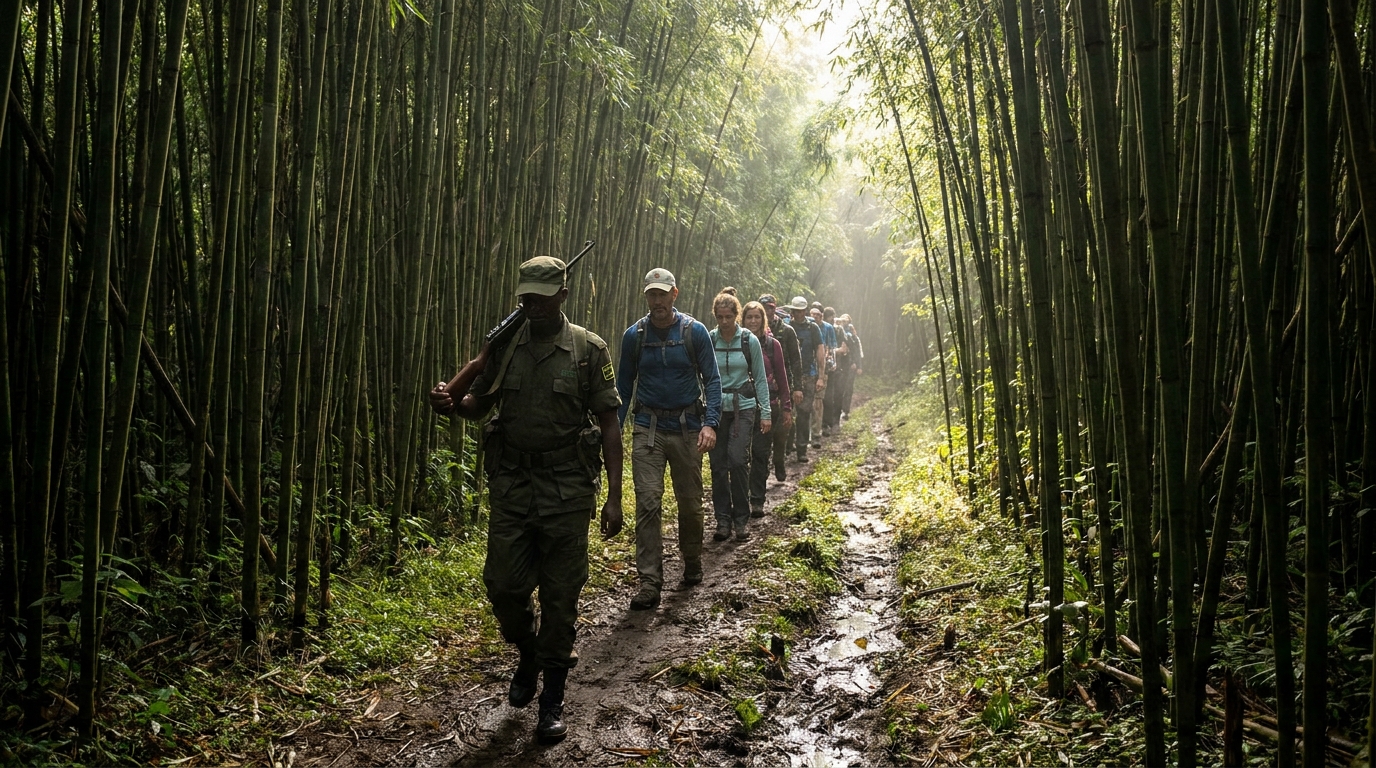
The vegetation shifts with altitude: bamboo forest at lower elevations (where many gorilla families spend time), Hagenia-Hypericum forest in the middle zones, and Afro-alpine moorland and heath near the summits. The bamboo zone in particular has an otherworldly quality — tall green stems filtering pale morning light, silence except for birds and the distant grunt of a silverback.
Rwanda Gorilla Permit — Cost, Booking and What You Need to Know
The Current Permit Cost
A Rwanda gorilla trekking permit costs USD $1,500 per person in 2026, issued by the Rwanda Development Board (RDB). This is the most expensive single wildlife activity permit in Africa and among the most expensive anywhere in the world.
The price is not an accident. Rwanda’s government made a deliberate decision to position gorilla trekking as an ultra-premium, low-volume, high-revenue experience. The philosophy is sound: fewer visitors, more money per visitor, less disturbance to the animals, more funds directed to conservation and community benefit.
The permit includes all park and ranger fees for the trek and the one-hour gorilla encounter. Accommodation, meals, transfers, and porter hire are separate.
How Many Families, How Many Permits?
Rwanda currently has 10 habituated gorilla families open for tourist visits. Each family receives a maximum of 8 visitors per day. This gives Rwanda a daily ceiling of just 80 gorilla trekking permits — significantly fewer than Uganda’s availability.
This scarcity is both the reason permits sell out quickly and the reason the experience feels exclusive when you are there.
How Far in Advance to Book
- Peak season (June–September, December–January): Book 5 to 6 months in advance. These months are fully booked at top lodges and many permit dates sell out completely.
- Shoulder season (February–May, October–November): 2 to 3 months is generally sufficient, but earlier is always better.
Crescent Shores Retreats handles Rwanda permit acquisition on your behalf. We work directly with the RDB and with trusted Rwanda ground partners to secure your permit date and preferred family before you confirm any other booking element.
Rwanda’s Notable Gorilla Families
Your guide will assign you to a gorilla family on the morning of your trek based on current family locations and group composition. Here is a brief guide to the best-known families.
Susa Group — The most famous family, studied by Dian Fossey herself. One of the largest groups with up to 28 members. Located at higher altitude, making it one of the more physically demanding treks — but the reward of finding the family Fossey dedicated her life to is extraordinary.
Sabyinyo Group — Often the easiest family to reach, as they tend to range at lower altitudes near the park boundary. Ideal for older travellers or those concerned about physical fitness.
Amahoro Group — Amahoro means “peace” in Kinyarwanda, and the name reflects the family’s calm, settled temperament. A large group with many juveniles — excellent for photography.
Hirwa Group — Formed from members of several other families in 2006. One of the more dynamic groups to visit, with an interesting social structure.
Umubano Group — Smaller family, typically found at middle altitude. Less visited than Susa or Amahoro, giving a quieter experience.
The remaining five families (Agashya, Kwitonda, Karisimbi, Muhoza, Isimbi) round out Rwanda’s allocation and vary in size, altitude range, and character.
Your specific family assignment will be made on trek day — you cannot request a specific family in advance, though guides take note of traveller preferences and physical fitness when making assignments.
What to Expect on Your Rwanda Gorilla Trek
The Morning Briefing
You arrive at Kinigi park headquarters by approximately 7:00 to 7:30 AM on trek day. The RDB ranger team delivers a 30-minute briefing covering gorilla behaviour, photography rules (no flash, 7-metre minimum distance), health protocols (anyone with flu or cold symptoms must not trek), and what to do if a gorilla approaches you — which they will.
Groups are divided, family assignments announced, and you set off with your ranger and guide.
The Trek
Rwanda’s treks are, on average, somewhat shorter than Uganda’s because many gorilla families in Volcanoes National Park range at lower altitudes — the agricultural land butts right up against the park boundary, and families often rest in the bamboo zone close to the edge. Many Rwanda treks reach the gorillas within 1 to 2 hours. Some go longer. The terrain is steep, wet, and demanding regardless of duration.
The Hour With the Gorillas
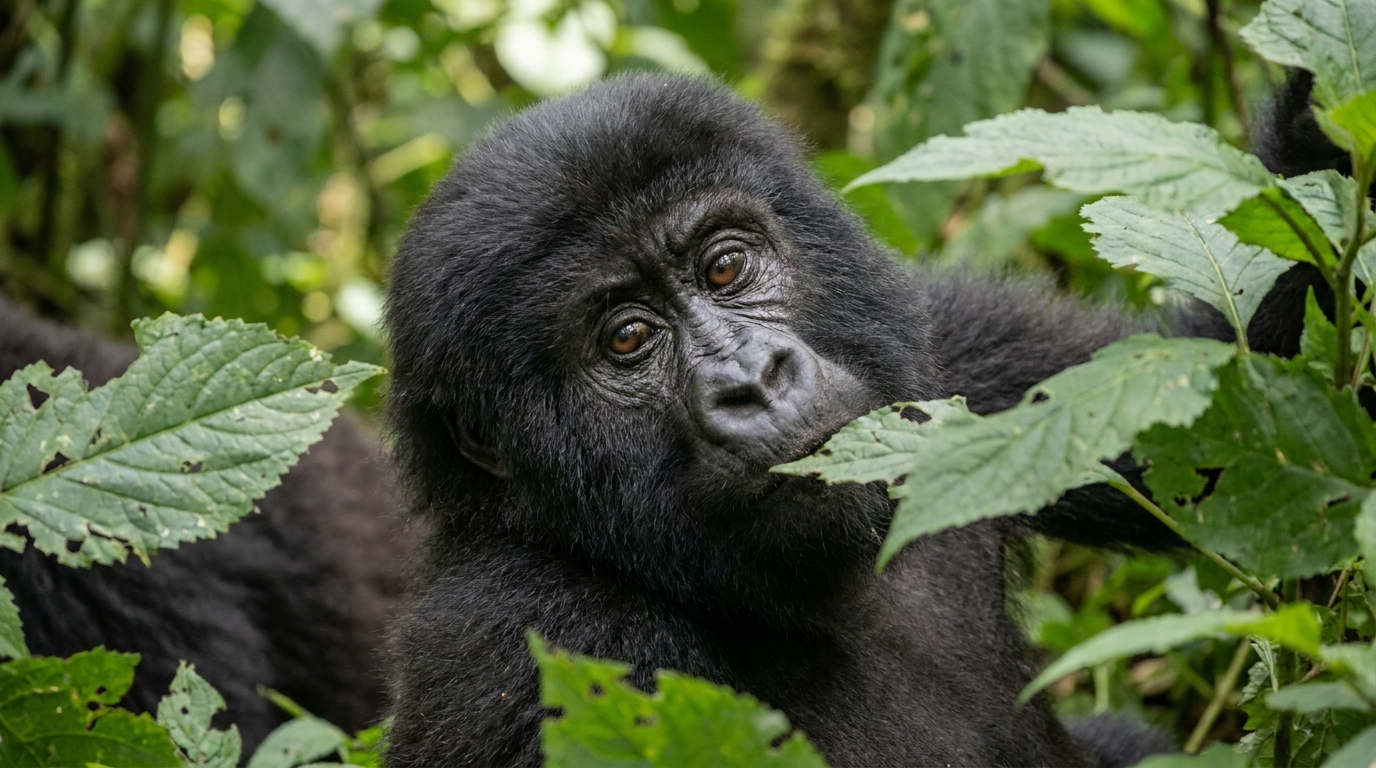
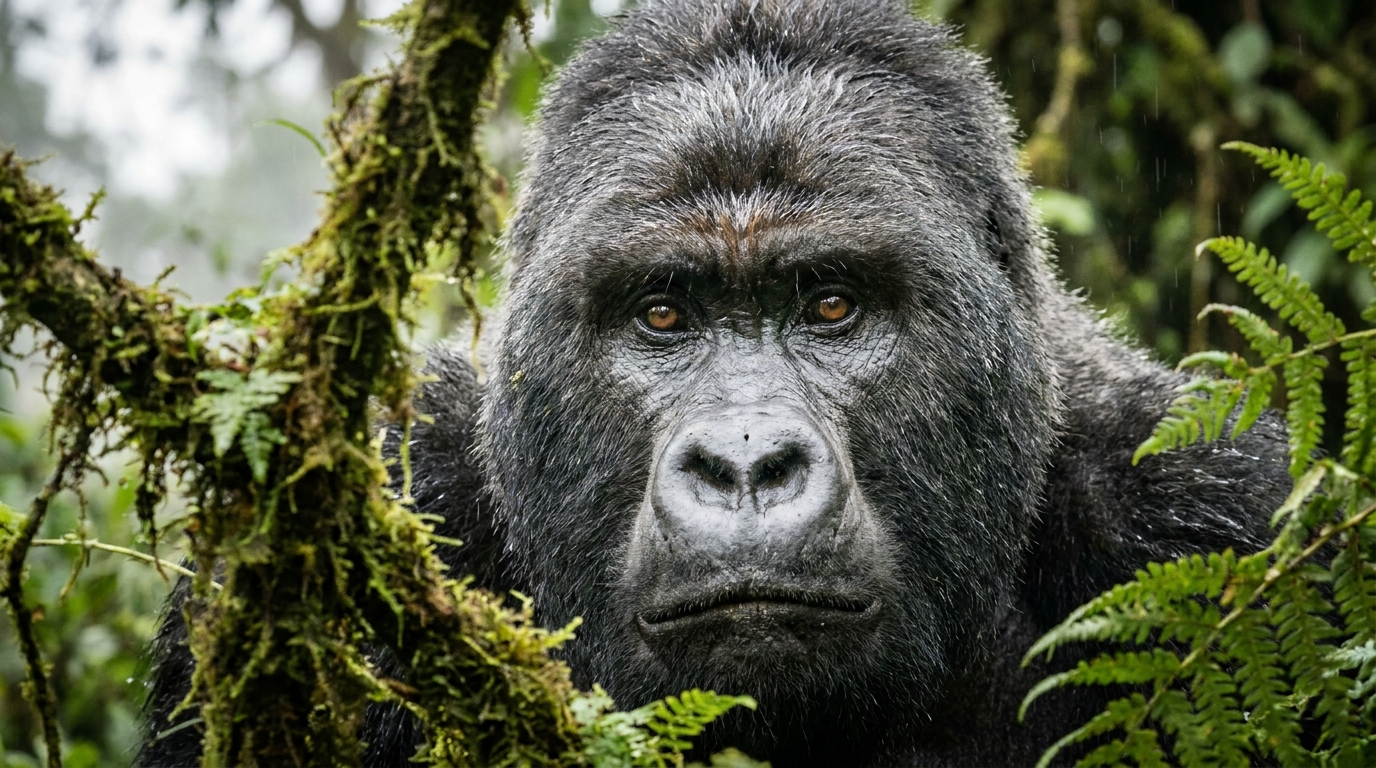
When your guide stops, crouches, and signals silence, you are close. Perhaps already watching. A silverback in Rwanda’s forest looks different from anywhere you have seen gorillas in a zoo or on television — enormous, calm, entirely at ease, pulling handfuls of bamboo shoots with the methodical patience of an animal that has nothing to prove and no urgency about anything.
Rwanda’s habituated families have been visited by humans for decades. They are accustomed not just to human presence but to the specific business of a tourist group — the cameras, the whispered instructions, the shuffling for position. They are, with great generosity, indifferent to it.
You have one hour. The rule is absolute and internationally consistent — it applies in Rwanda and Uganda alike, to every visitor regardless of how much the permit cost or who arranged the booking. One hour. In our experience, every person who has ever done a gorilla trek wishes that rule said two.
Beyond Gorillas — What Else to Do in Rwanda
Rwanda is a small country — roughly the size of Wales or the state of Maryland — and it is astonishingly diverse in what it offers travellers.
Golden Monkey Trekking — Volcanoes National Park
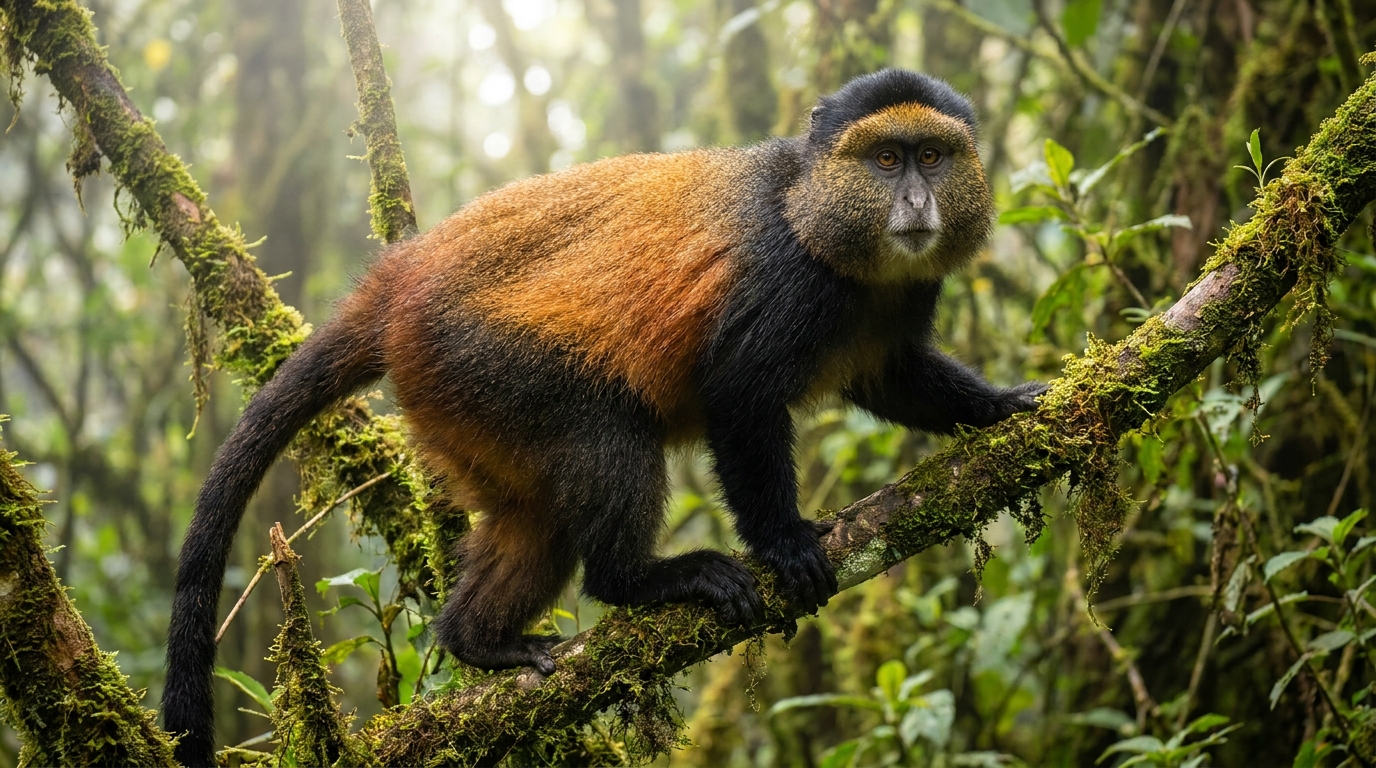
The golden monkey (Cercopithecus kandti) is found only in the Virunga Volcanoes — it exists nowhere else on earth. Volcanoes National Park has habituated golden monkey groups available for trekking at a permit cost of USD $100 per person. The trek format mirrors gorilla trekking — one hour with a habituated group, guided by rangers — but in the lower bamboo forest, often close to the park boundary.
Golden monkeys are spectacular — vivid orange-gold patches on a black body, quick and acrobatic in the bamboo. The trek is physically easier than gorilla trekking and is often combined with it for a full day in the park.
The Dian Fossey Tomb Hike
From Kinigi headquarters, a 2 to 3-hour guided hike leads to the original Karisoke Research Center camp where Dian Fossey lived and worked for 18 years, and to her grave alongside Digit — the gorilla whose killing galvanised the global conservation movement. The site is atmospheric, moving, and historically significant in a way that is difficult to overstate for anyone who has read Gorillas in the Mist or watched the film.
Akagera National Park — Rwanda’s Big Five Safari
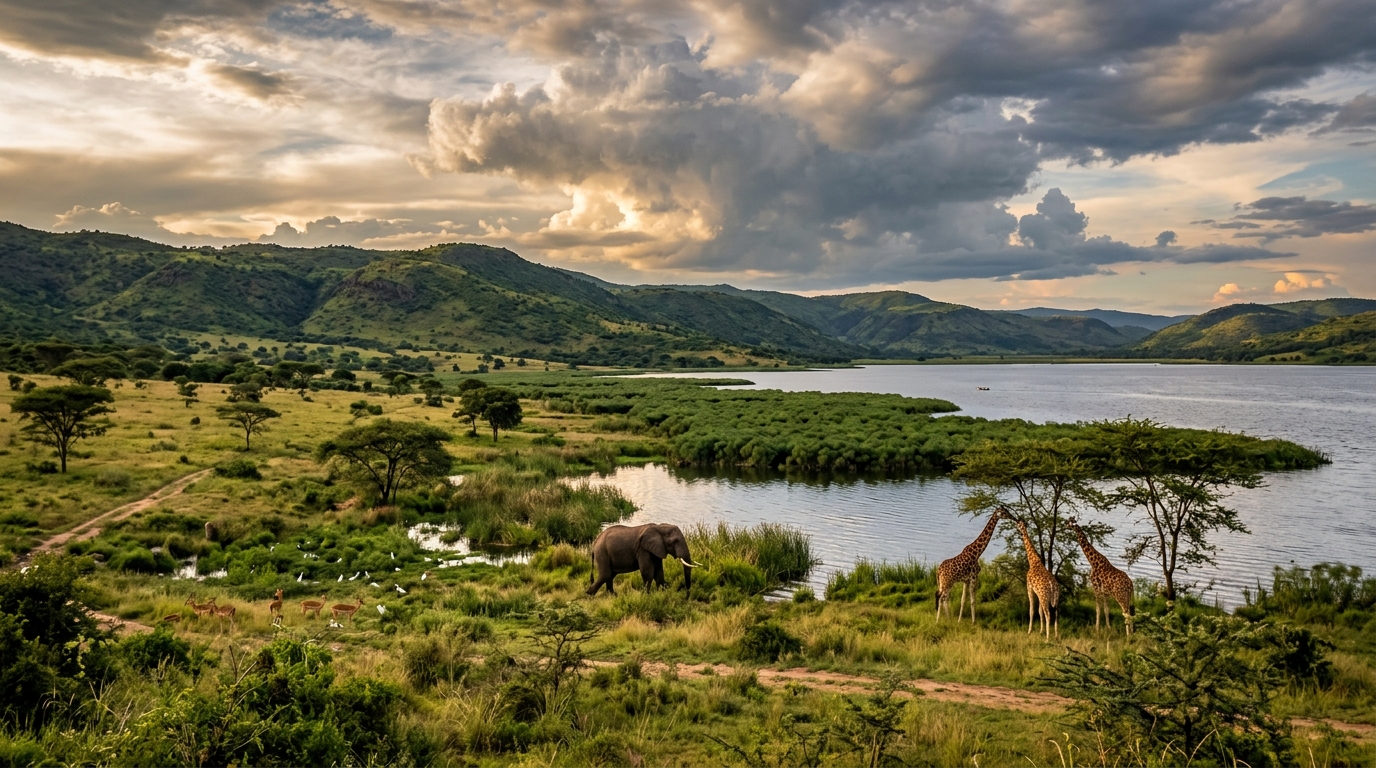
Four hours east of Kigali, Akagera National Park protects a remarkable landscape of savanna, lakes, and papyrus wetlands along the Tanzanian border. Lions (reintroduced in 2015), black rhino (reintroduced in 2017), elephants, buffalo, and leopard complete the Big Five. The boat safari on Lake Ihema is one of the best in East Africa for hippos and birds.
Akagera offers a completely different Rwanda experience from the volcanic northwest — flat, wide, golden, with the feel of East African savanna that many travellers combine with Volcanoes for a full-country Rwanda itinerary.
Nyungwe Forest National Park
Rwanda’s third major wildlife destination. Nyungwe Forest is one of Africa’s oldest and most biodiverse montane rainforests, home to habituated chimpanzees (permit: USD $90), 13 primate species, and a spectacular canopy walkway suspended above the forest floor. Located in southwestern Rwanda near the Burundi border — ideal as a stopping point between Volcanoes and Akagera on a full-circuit Rwanda trip.
Kigali
Rwanda’s compact, remarkably clean capital is worth at least one night. The Kigali Genocide Memorial is a sobering and important site that provides essential context for Rwanda’s extraordinary recovery. The Kimironko market, the Inema Arts Center, and Kigali’s genuinely excellent restaurant scene round out a city that regularly surprises visitors who expect less.
Getting to Rwanda from Kenya
Nairobi to Kigali by Air
Multiple airlines operate direct daily flights from Jomo Kenyatta International Airport (JKIA) in Nairobi to Kigali International Airport (KGL). Airlines include RwandAir (Rwanda’s national carrier, excellent quality), Kenya Airways, and Ethiopian Airlines. Flight time: approximately 1 hour 20 minutes. Cost: approximately USD $100–$250 return depending on airline and booking lead time.
Crescent Shores Retreats coordinates Rwanda flights as part of any combined Kenya–Rwanda itinerary. We build the complete package — Naivasha excursion and Kenya safari first, then Nairobi to Kigali, then Volcanoes, Akagera, and back.
Kigali to Volcanoes National Park
From Kigali to the park headquarters at Kinigi is approximately 2 to 2.5 hours by road through Musanze (formerly Ruhengeri). The road is sealed, well-maintained, and passes through the rolling green hills that Rwanda is famous for. We arrange private road transfers from Kigali for all Rwanda packages.
Best Time to Go Gorilla Trekking in Rwanda
Mountain gorillas can be tracked year-round in Rwanda — they do not migrate and are present in the park in every month. Season affects trail conditions, not gorilla availability.
| Season | Months | Trail Conditions | Crowds | Notes |
|---|---|---|---|---|
| Dry (Peak) | Jun–Sep | Firm, less muddy | Busiest, book 5–6 months ahead | Best photography conditions |
| Dry (Peak) | Dec–Jan | Good conditions | Very busy | Popular for Christmas/New Year travel |
| Green Season | Feb–May | Muddy, lush forest | Quieter | Permit availability easier, lower accommodation rates |
| Short Rains | Oct–Nov | Variable | Moderate | Unexpectedly good for photography — mist and forest light |
Key note for Rwanda: The altitude of Volcanoes National Park means it is cooler than most East African safari destinations year-round, with temperatures often dropping to 10°C at night. Even in dry season, a warm fleece and waterproof jacket are essential — not optional.
Our recommendation: June to September is excellent and the most popular. December is the most luxurious time to visit with the Christmas and New Year lodge atmosphere at its peak. February to May is the best-value window and offers the most beautiful forest conditions — the mist and rain that make the forest look exactly as it should.
Plan Your Rwanda Gorilla Safari with Crescent Shores Retreats
We coordinate Rwanda gorilla trekking from permit acquisition through to your final transfer back to Kigali airport. As a Kenya-based East Africa operator, we specialise in combined Kenya–Rwanda itineraries — starting with Lake Naivasha and the Maasai Mara before flying to Kigali for Volcanoes National Park. One operator, one itinerary, one point of contact for the entire journey.
📞 WhatsApp or call: +254 790 292 838 📧 Email: welcome@crescentshoresretreats.com 🌐 Request Rwanda Safari Details: Contact Our Team 🌐 Also read: Uganda Gorilla Trekking Guide · Uganda vs Rwanda — Which is Right for You?
Frequently Asked Questions — Rwanda Gorilla Trekking
How much does a Rwanda gorilla trekking permit cost in 2026?
A Rwanda gorilla trekking permit costs USD $1,500 per person in 2026, issued by the Rwanda Development Board (RDB). This is the highest-priced gorilla permit in the world and reflects Rwanda’s deliberate policy of low-volume, high-revenue conservation tourism. The permit covers one hour with a single habituated gorilla family, with a maximum of 8 visitors per group per day. For a lower-cost alternative, Uganda’s gorilla permit costs USD $700 per person.
How many gorilla families can you trek in Volcanoes National Park?
Volcanoes National Park has 10 habituated gorilla families currently open to tourist visits, including the famous Susa, Amahoro, Sabyinyo, Hirwa, and Umubano groups. Each family accepts a maximum of 8 visitors per day, giving Rwanda a daily maximum of approximately 80 gorilla trekking permits. You are assigned a family on the morning of your trek based on your group composition and current family locations — specific family requests cannot be guaranteed.
Is Rwanda gorilla trekking worth the $1,500 permit price?
For the overwhelming majority of people who do it, yes — without hesitation. The gorilla encounter itself is identical to Uganda’s experience, but Rwanda adds an accessibility advantage (2 hours from Kigali), exceptional luxury lodge options, the ability to combine with golden monkey trekking in the same park, and the profound legacy of Dian Fossey’s conservation work. Travellers who compare the $1,500 Rwanda permit to the $700 Uganda permit on cost alone often choose Uganda — but those who research what the full Rwanda experience includes very often choose Rwanda. Compare the two in detail here.
How do I get from Nairobi to Volcanoes National Park?
Fly from Nairobi JKIA to Kigali International Airport — approximately 1 hour 20 minutes, with multiple daily flights on RwandAir, Kenya Airways, and Ethiopian Airlines. From Kigali, drive approximately 2 to 2.5 hours by road to the park headquarters at Kinigi near Musanze. Crescent Shores Retreats arranges all flights and transfers as part of any Rwanda gorilla safari package booked through us.
Can I do gorilla trekking and golden monkey trekking on the same day?
Technically no — park regulations do not permit the same visitor to do both activities on the same day. In practice, gorilla treks return to HQ by midday to 1 PM, and golden monkey treks depart at the same early morning time. The standard approach is to book gorilla trekking on Day 1 and golden monkey trekking on Day 2, which works perfectly with a 2-night stay near the park. The golden monkey permit costs USD $100 per person and the trek is typically shorter and less physically demanding than the gorilla trek.
What is the practical difference between gorilla trekking in Rwanda and Uganda?
The gorilla encounter itself is identical in both countries — one hour with a habituated mountain gorilla family. Rwanda’s advantages are: closer to an international airport (2 hours from Kigali vs 7–8 hours from Entebbe to Bwindi), a more polished and organised park experience, and golden monkey trekking in the same park. Uganda’s advantages are: lower permit cost (USD $700 vs $1,500), more gorilla families available, and the ability to combine with chimpanzee trekking in Kibale Forest. For our full side-by-side comparison, read the Uganda vs Rwanda Gorilla Trekking Guide.
— Crescent Shores Retreats, Naivasha, Kenya Naivasha-based safari tour operator · Kenya · Tanzania · Uganda · Rwanda +254 790 292 838 · welcome@crescentshoresretreats.com

Leave A Comment