
By Crescent Shores Retreats · Naivasha, Kenya · Published May 2026 · 11 min read
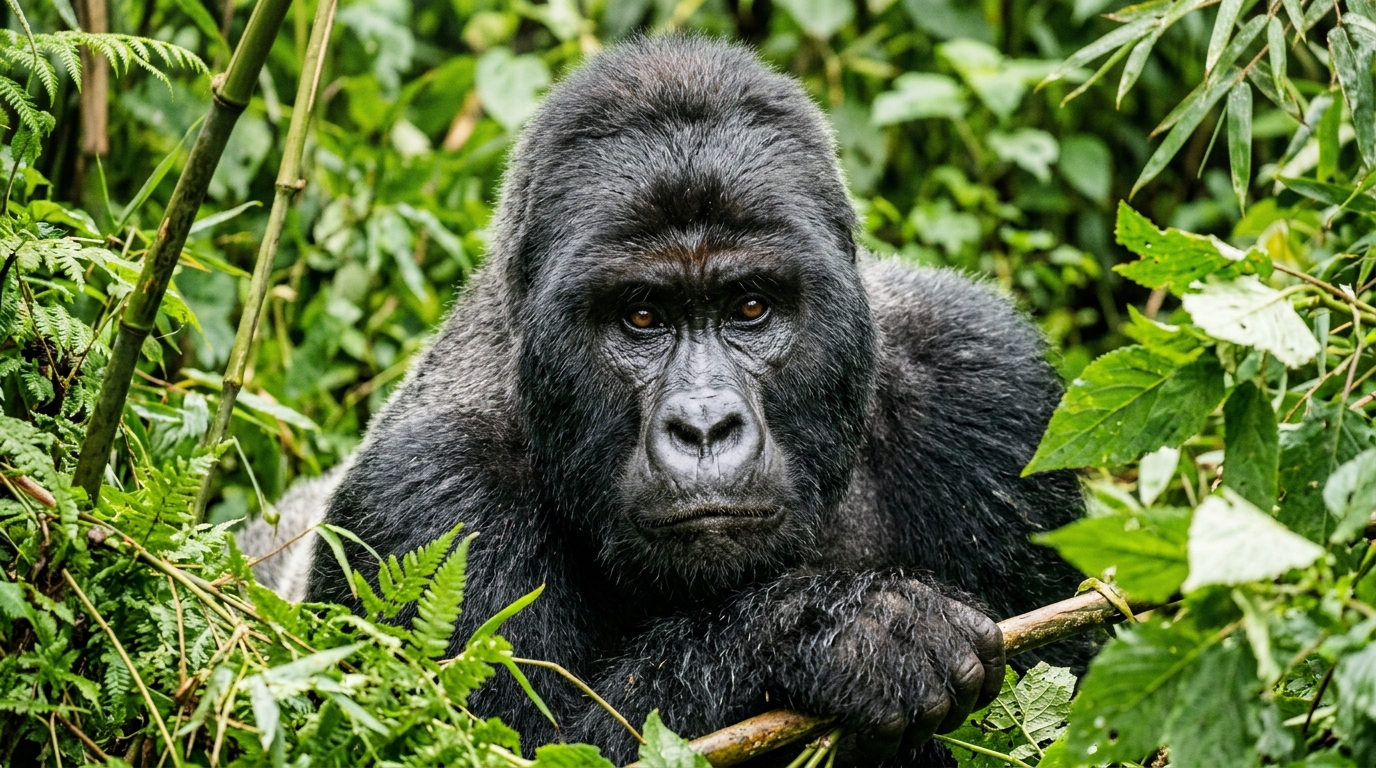
The mountain gorillas in Uganda and Rwanda are the same animals. They share the same Virunga Massif mountain range, the same forests, the same family structures, and — crucially — they provide the same one-hour encounter, the same habituation process, and the same profound, life-altering experience for the visitor standing in front of them.
So if the gorillas are identical, what exactly is the difference between gorilla trekking in Uganda and gorilla trekking in Rwanda?
The answer is: the permit cost, the surrounding infrastructure, the add-on wildlife, the luxury lodge options, the ease of access, and the overall character of the experience. These differences are significant, and for a trip costing between USD $3,000 and $10,000 per person, they are worth understanding in full before you book.
We organise gorilla trekking in both countries — as standalone packages and as part of combined East Africa itineraries departing from our Kenya base. This guide is our honest, firsthand comparison.
The Short Answer
Choose Uganda if:
- Budget matters — the permit saving is USD $800 per person ($1,600 per couple)
- You want wildlife beyond gorillas — Uganda uniquely combines gorilla trekking with chimpanzee trekking
- You want a rawer, wilder, less packaged experience
- You have 6 or more days in the region
Choose Rwanda if:
- Accessibility is a priority — Kigali to the park is 2 hours; Uganda’s Bwindi is 7–8 hours from Entebbe
- You want the finest luxury lodges in Africa alongside your gorilla trek
- You are combining with a Kenya or Tanzania safari on a tight schedule
- The Dian Fossey legacy and conservation history matter to you
Choose both if: You have 10 or more days. A combined Uganda–Rwanda gorilla itinerary is among the most extraordinary wildlife trips on earth.
Side-by-Side: Uganda vs Rwanda Gorilla Trekking
| Factor | Uganda (Bwindi) | Rwanda (Volcanoes NP) |
|---|---|---|
| Gorilla permit cost | USD $700 per person | USD $1,500 per person |
| Habituated gorilla families | 19 (Bwindi) + 1 (Mgahinga) | 10 |
| Daily permit capacity | Up to 160 (20 families × 8) | 80 (10 families × 8) |
| Nearest international airport | Entebbe (EBB) | Kigali (KGL) |
| Airport to park (road) | 7–8 hours (to Buhoma sector) | 2–2.5 hours (to Kinigi) |
| Domestic flight option | Yes (EBB to Kihihi, ~1 hr) | Not required |
| Night drives | Not applicable to gorilla activity | Not applicable |
| Chimpanzee trekking nearby | ✅ Kibale NP (USD $200) | ❌ (Nyungwe — separate trip) |
| Golden monkey trekking | ✅ Mgahinga (separate trip) | ✅ Volcanoes NP (same park, USD $100) |
| Big Five safari nearby | ✅ Queen Elizabeth NP | ✅ Akagera NP |
| Luxury lodge options | Good | Exceptional |
| Trek difficulty | Variable: easy to very hard | Moderate: shorter average trek |
| Overall atmosphere | Wild, remote, adventurous | Polished, accessible, refined |
| Best combined with | Chimp trek, Kenya safari | Kenya safari, Rwanda city trip |
Permit Cost — The Decision Most People Start With
A Uganda gorilla trekking permit costs USD $700 per person. A Rwanda gorilla trekking permit costs USD $1,500 per person. That is a difference of USD $800 per person, or USD $1,600 for a couple on permits alone before you have paid for a single night’s accommodation.
On a 5-day trip costing USD $4,000 to $6,000 per person all-in, that permit saving is meaningful. It is the difference between including a luxury lodge upgrade, adding a chimpanzee trekking day, or simply stretching the trip by one additional night.
Why does Rwanda charge more than twice Uganda’s rate?
Rwanda’s government made a deliberate strategic choice to position gorilla trekking as an ultra-premium, low-volume experience. The philosophy is conservation economics: fewer visitors spending more per person generates the same or greater revenue with less disturbance to the animals. Rwanda charges USD $1,500 not because the gorilla experience is better — it is the same — but because it has decided to compete at the top of the luxury wildlife market rather than the volume market.
Both fee structures work. Both fund conservation effectively. The question for you is purely personal: does the USD $800 saving change your overall trip planning meaningfully?
Gorilla Families — Availability and Flexibility
Uganda has 19 habituated gorilla families available for trekking in Bwindi across four sectors (Buhoma, Rushaga, Ruhija, Nkuringo), plus one family at Mgahinga Gorilla National Park. With a daily maximum of 8 visitors per family, Uganda can theoretically accommodate up to 160 gorilla trekking visitors per day across its Bwindi families.
This gives Uganda significantly greater permit availability and booking flexibility — particularly valuable for travellers with fixed or short booking windows.
Rwanda has 10 habituated gorilla families in Volcanoes National Park, giving a daily maximum of 80 permits. Rwanda’s smaller capacity means permits sell out faster at peak season, requiring earlier booking (5 to 6 months ahead for June–September and December–January).
Practical implication: If you are booking 2 to 3 months in advance and flexibility on permit date matters, Uganda is easier to secure. If you are booking well ahead and dates are fixed, both countries are equally manageable through a good operator.
Getting There — Accessibility From Kenya and Nairobi
This is Rwanda’s clearest practical advantage over Uganda, and for time-pressed travellers it can be decisive.
To reach Bwindi (Uganda) from Nairobi:
- Fly Nairobi JKIA → Entebbe International Airport (~1 hr 30 min)
- Either: Road transfer Entebbe → Bwindi Buhoma sector (~7–8 hours)
- Or: Road Entebbe → Kajjansi (~1 hr), then domestic flight Kajjansi → Kihihi airstrip (~1 hr), then 1 hr road to camp
Minimum travel time from leaving Nairobi to arriving at your Bwindi camp: approximately 11 to 12 hours by the fastest route. The road-only option is a long day.
To reach Volcanoes National Park (Rwanda) from Nairobi:
- Fly Nairobi JKIA → Kigali International Airport (~1 hr 20 min)
- Road transfer Kigali → Kinigi park headquarters (~2–2.5 hours)
Total time: approximately 4 to 4.5 hours. Arrive Nairobi morning, land Kigali midday, reach your lodge in time for dinner and trek the next morning.
For a combined Kenya–gorilla trip of 10 days or less, Rwanda’s accessibility advantage is significant. For a longer dedicated gorilla-and-primate trip of 7 to 10 days in Uganda alone, the longer journey time is simply absorbed into the itinerary.
What You Can Add On — The Surrounding Wildlife
This is where Uganda wins clearly for travellers who want wildlife diversity beyond gorillas.
Uganda’s Wildlife Additions
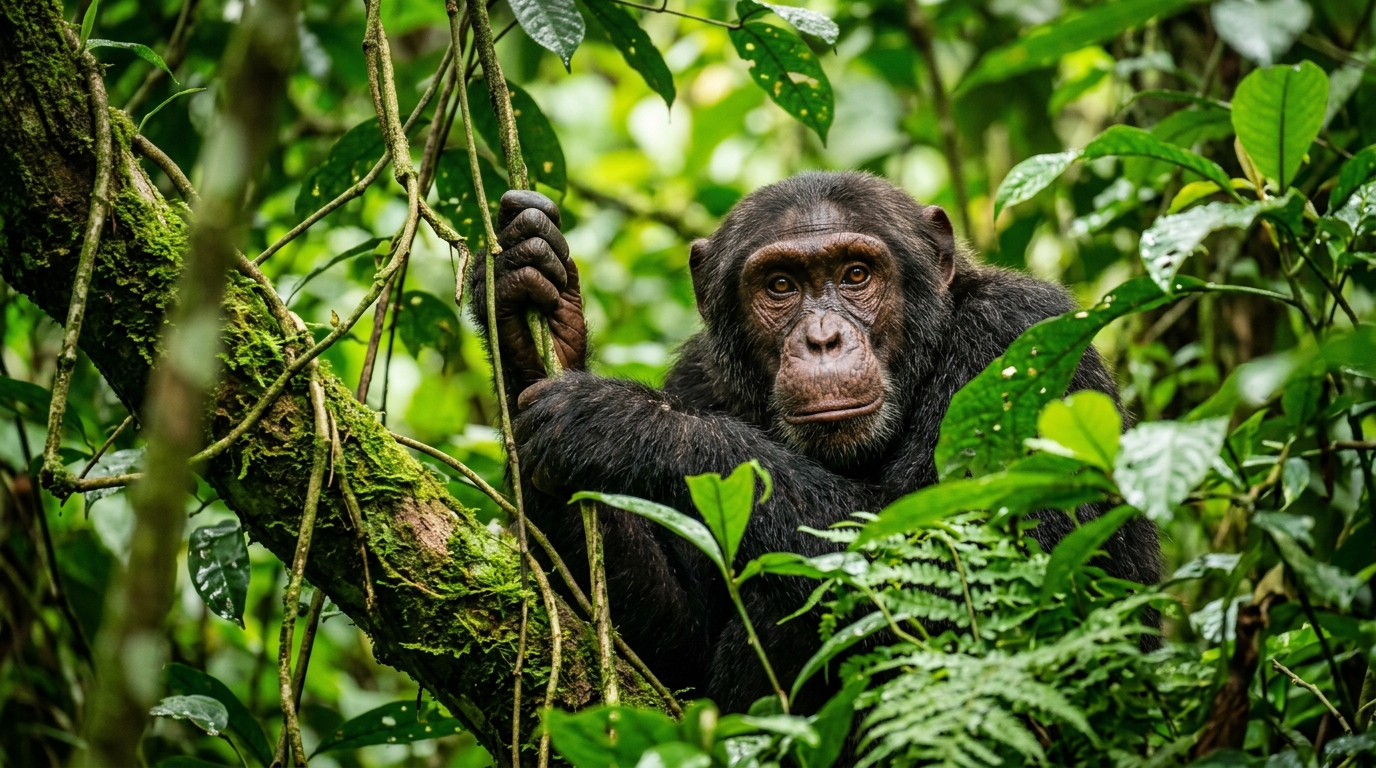
Chimpanzee trekking in Kibale National Park (permit: USD $200) is Uganda’s most celebrated add-on — and it is genuinely extraordinary. Kibale has the highest density of primates in Africa, with over 1,000 habituated chimpanzees. The trek follows a similar format to gorilla trekking — professional guide, one hour with a habituated community — but in dense tropical forest rather than mountain terrain. Uganda is the only country on earth where you can reliably trek both mountain gorillas and chimpanzees on the same trip.
Queen Elizabeth National Park sits between Bwindi and Kibale and offers a full Big Five game experience including the famous tree-climbing lions of the Ishasha sector and one of Africa’s best boat safaris on the Kazinga Channel — exceptional hippo, buffalo, and bird densities.
Murchison Falls National Park (for longer Uganda itineraries) adds the world’s most powerful waterfall and excellent Nile game viewing.
Rwanda’s Wildlife Additions
Golden monkey trekking in Volcanoes National Park itself (permit: USD $100) is Rwanda’s most convenient add-on — same park, booked for the day after your gorilla trek. The golden monkey is found only in the Virunga Volcanoes — a species exclusive to Rwanda, Uganda and the DRC.
Akagera National Park in eastern Rwanda offers a complete Big Five safari including reintroduced lions and black rhinos, with excellent lake and papyrus wetland scenery. A 3-hour drive from Volcanoes National Park.
Nyungwe Forest National Park (chimpanzees and a spectacular canopy walkway) is Rwanda’s equivalent to Kibale, though it requires a separate southern trip.
The Experience on the Day — Any Difference?
Honestly: very little. Here is what is the same in both countries:
- A maximum of 8 visitors per gorilla family
- A 45-minute briefing at headquarters on behaviour and health protocols
- Professional UWA (Uganda) or RDB (Rwanda) ranger accompanying the trek
- One hour with the gorilla family — strictly enforced globally
- No flash photography
- The gorillas themselves — habituated, calm, often remarkably close
What differs in practice:
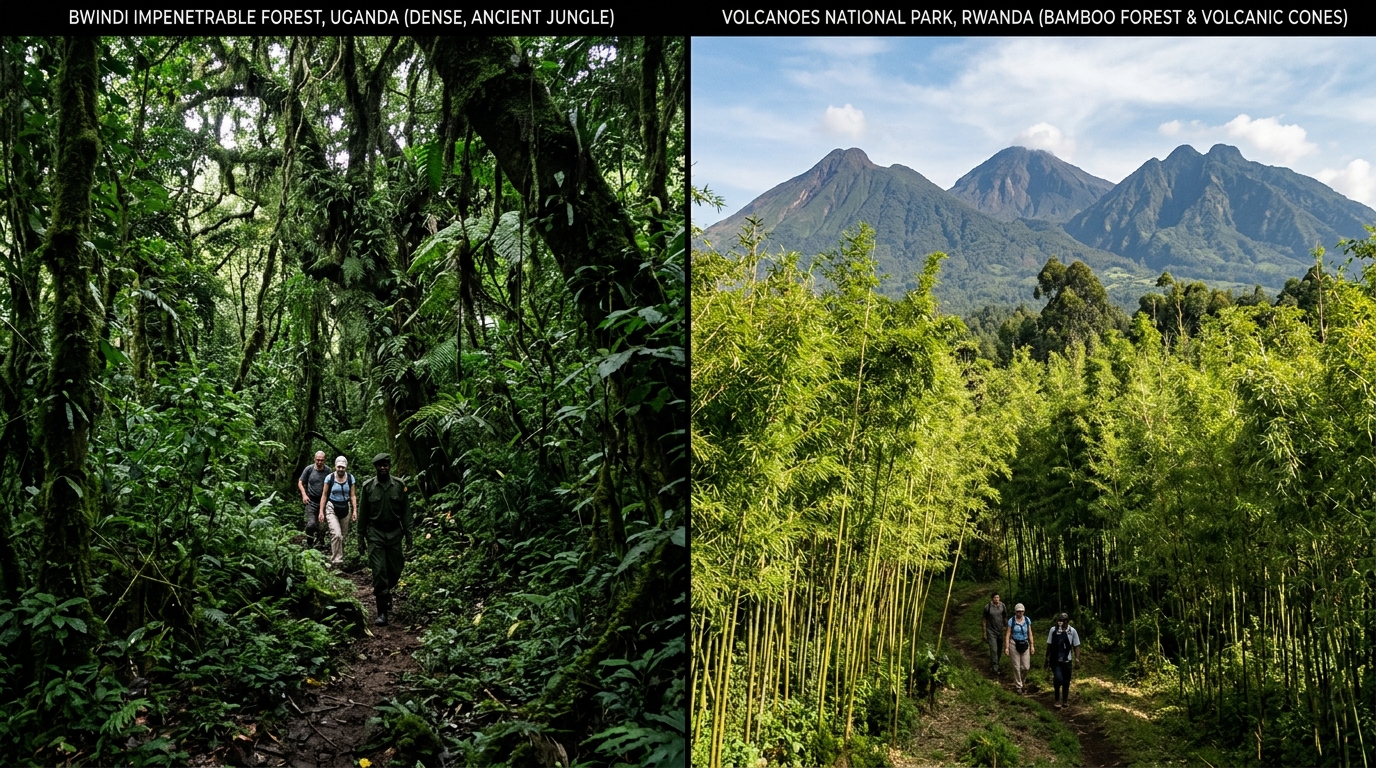
Trek duration: Rwanda’s families tend to range at lower altitudes near the park boundary, particularly the Sabyinyo family. Many Rwanda treks reach the gorillas within 1 to 2 hours. Uganda’s Bwindi sectors vary dramatically — the Ruhija sector at 2,350 metres can involve 3 to 6-hour treks on very steep, muddy terrain.
Physical difficulty: Rwanda is generally more accessible for older travellers or those with limited fitness. Uganda’s Bwindi can be physically demanding — particularly the Ruhija and Nkuringo sectors. Porters are available and recommended in both countries.
Atmosphere: Rwanda’s experience is more organised, predictable, and polished. Uganda’s Bwindi has a wilder, more remote quality — the forest is 25,000 years old and feels it. Neither is better. Both are profound. The difference is character.
Accommodation — Two Different Worlds
Rwanda’s lodges surrounding Volcanoes National Park include some of the most celebrated safari properties in Africa. Singita Kwitonda Lodge, Bisate Lodge, One&Only Gorilla’s Nest, and Sabyinyo Silverback Lodge regularly appear on global best-of lists. At USD $1,000 to $2,500 per person per night, they offer private volcanic panoramas, Michelin-quality cuisine, and service that redefines what a bush lodge can be.
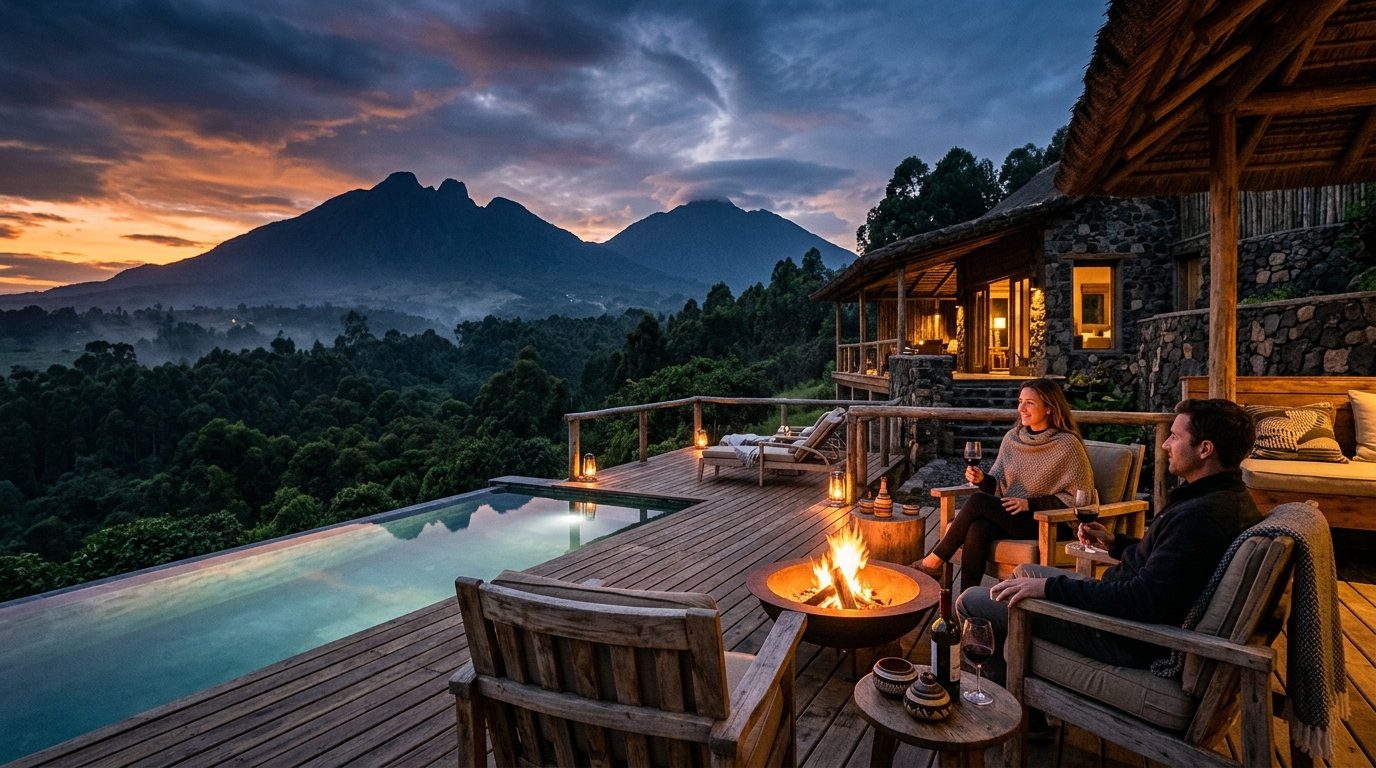
Uganda’s Bwindi lodges are good — some are genuinely excellent — but the luxury level generally does not match Rwanda’s top properties. The investment in premium tourism infrastructure around Bwindi has been more recent and less comprehensive. Mid-range to upper-mid-range is the sweet spot for Uganda gorilla accommodation — around USD $200 to $500 per person per night.
Bottom line: If the quality of the bed and dinner matters as much as the quality of the gorilla encounter, Rwanda is the destination. If you are primarily there for the wildlife and are comfortable with comfortable rather than extraordinary accommodation, Uganda delivers the same gorillas at a significantly lower overall cost.
Who Should Choose Uganda?
- Budget-conscious travellers for whom USD $800 per person permit saving is meaningful
- Wildlife diversity seekers who want chimpanzees and Big Five alongside gorillas
- Adventure travellers who want a rawer, less packaged East Africa experience
- Those with 7+ days who can absorb the longer journey time to Bwindi
- First-time gorilla trekkers on a mid-range budget who want the best value
Read the full guide: Uganda Gorilla Trekking Safari: The Complete 2026 Guide →
Who Should Choose Rwanda?
- Luxury travellers for whom the lodge experience matters as much as the wildlife
- Time-pressed travellers who need the fastest route to gorillas — 4.5 hours from Nairobi
- Those combining with Kenya or Tanzania who need easy flight connections
- Second-time gorilla trekkers who have done Uganda and want the contrast of Rwanda’s polished experience
- Those drawn to the Dian Fossey legacy and Volcanoes National Park’s conservation history
- Couples on honeymoon for whom the luxury lodges are central to the trip
Read the full guide: Rwanda Gorilla Trekking: Everything You Need to Know →
Can You Do Both Uganda AND Rwanda?
Yes — and a significant number of our clients do. A combined Uganda–Rwanda gorilla itinerary is one of the most extraordinary wildlife trips available anywhere on earth. Here is what a 10-day combined trip looks like, departing from Nairobi:
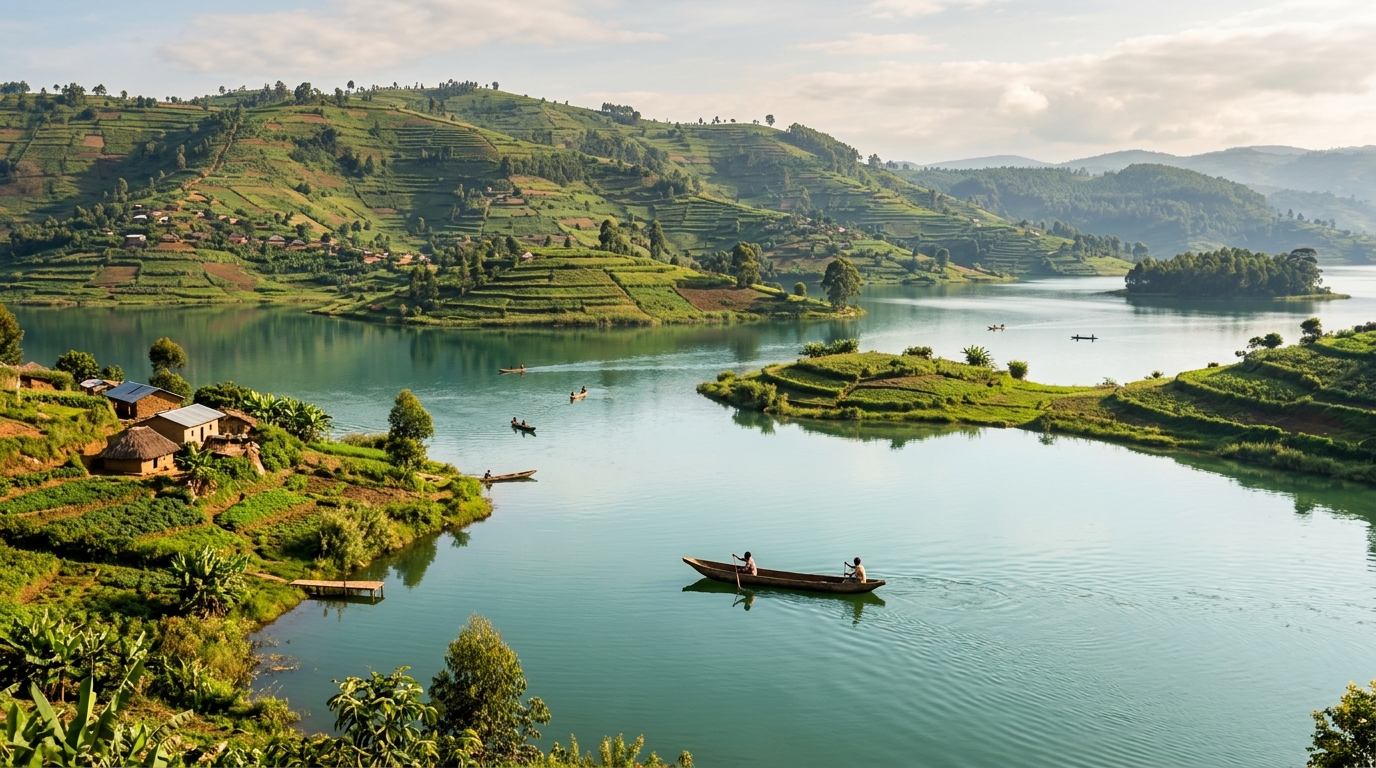
Day 1: Fly Nairobi → Entebbe. Transfer to Bwindi (road, or flight to Kihihi) Days 2–3: Bwindi — mountain gorilla trekking (2 permits: USD $1,400 per person) Day 4: Transfer Bwindi → Lake Bunyonyi for recovery and scenery Day 5: Transfer Lake Bunyonyi → Kibale National Park Day 6: Kibale — chimpanzee trekking (1 permit: USD $200 per person) Day 7: Transfer Kibale → Kigali via road (6–7 hours) or via Entebbe flight Day 8: Transfer Kigali → Volcanoes National Park Day 9: Volcanoes NP — mountain gorilla trekking (1 permit: USD $1,500 per person) + optional golden monkey trek next morning Day 10: Transfer to Kigali airport. Return to Nairobi
Total permits per person on this itinerary: USD $700 + $700 + $200 + $1,500 = USD $3,100 in permits alone. This is a serious investment — but for travellers who can make it, the combination of two countries, two gorilla families, and chimpanzee trekking across four unique ecosystems creates a trip with no parallel in wildlife travel.
Crescent Shores Retreats coordinates the complete combined itinerary — flights, road transfers, all permits, accommodation, and guides across both countries — as a single package from our Kenya base.
Plan Your Gorilla Safari with Crescent Shores Retreats
Whether you choose Uganda, Rwanda, or both, we handle every element of the booking. As a Kenya-based East Africa operator, we routinely build Kenya-Uganda, Kenya-Rwanda, and Kenya-Uganda-Rwanda combined itineraries that start from Naivasha and flow logically across the region.
 WhatsApp or call: +254 790 292 838
  Email: welcome@crescentshoresretreats.com
  Uganda guide: Uganda Gorilla Trekking Safari → Rwanda guide: Rwanda Gorilla Trekking Guide → Request a combined quote: Contact Our Team →
Frequently Asked Questions — Uganda vs Rwanda Gorilla Trekking
Is Uganda or Rwanda better for gorilla trekking?
Neither is objectively better — the gorilla encounter is identical in both countries. Uganda is better for budget-conscious travellers (USD $700 vs $1,500 permit), for wildlife diversity (unique chimpanzee trekking combination), and for a wilder atmosphere. Rwanda is better for luxury travellers, for accessibility from Kigali (2 hours to the park), and for those who want the finest lodges in Africa alongside their gorilla trek. Your travel budget, available time, and surrounding priorities determine which is right for you.
How much cheaper is gorilla trekking in Uganda than Rwanda?
A Uganda gorilla trekking permit costs USD $700 per person. A Rwanda permit costs USD $1,500 per person — a difference of USD $800 per person or USD $1,600 for a couple. On a typical full 5-day gorilla package, Uganda is approximately 30 to 40% cheaper overall than an equivalent Rwanda package when you factor in the permit difference alongside similar accommodation tiers.
Which country has more gorilla families available to trek?
Uganda has significantly more gorilla families available. Bwindi Impenetrable National Park has 19 habituated gorilla families across four sectors, plus one additional family at Mgahinga Gorilla National Park — giving a potential daily capacity of up to 160 gorilla trekking permits. Rwanda’s Volcanoes National Park has 10 habituated families, giving a maximum of 80 daily permits. Uganda’s greater availability provides more booking flexibility, particularly important for travellers with limited advance booking lead time.
Is it worth doing gorilla trekking in both Uganda and Rwanda?
For travellers with 10 or more days in the region, yes — emphatically. Trekking two different gorilla families in two different countries, combined with chimpanzee trekking in Uganda’s Kibale Forest, creates a trip with no equivalent in wildlife travel. The combined permit cost (typically USD $2,900 to $3,100 per person for two gorilla and one chimp permit) is significant, but the experience is proportionally extraordinary. Crescent Shores builds and operates combined Uganda–Rwanda gorilla itineraries as a single package.
Can I combine Kenya, Uganda and Rwanda in one trip?
Yes. A Kenya–Uganda–Rwanda combination is one of Crescent Shores’ most ambitious and rewarding itineraries. A typical 14-day version starts with Lake Naivasha and Maasai Mara (Kenya), flies to Entebbe for Bwindi gorilla trekking and Kibale chimpanzees (Uganda), then crosses to Kigali for Volcanoes National Park (Rwanda) before returning to Nairobi. We manage permits, flights, and transfers across all three countries as a single seamlessly planned package.
What is the best time for gorilla trekking in Uganda and Rwanda?
Mountain gorillas can be trekked year-round in both countries — they do not migrate. The dry seasons (June–August and December–February) offer firmer trails, clearer skies, and the best photography conditions. The green seasons (March–May and September–November) offer lower accommodation prices, fewer visitors, and lush forest atmosphere. July to August is the busiest and most expensive period in both countries — book 5 to 6 months ahead. For the green season, 6 to 8 weeks ahead is often sufficient but earlier is always better.
— Crescent Shores Retreats, Naivasha, Kenya Naivasha-based safari tour operator · Kenya · Tanzania · Uganda · Rwanda +254 790 292 838 · welcome@crescentshoresretreats.com

Leave A Comment